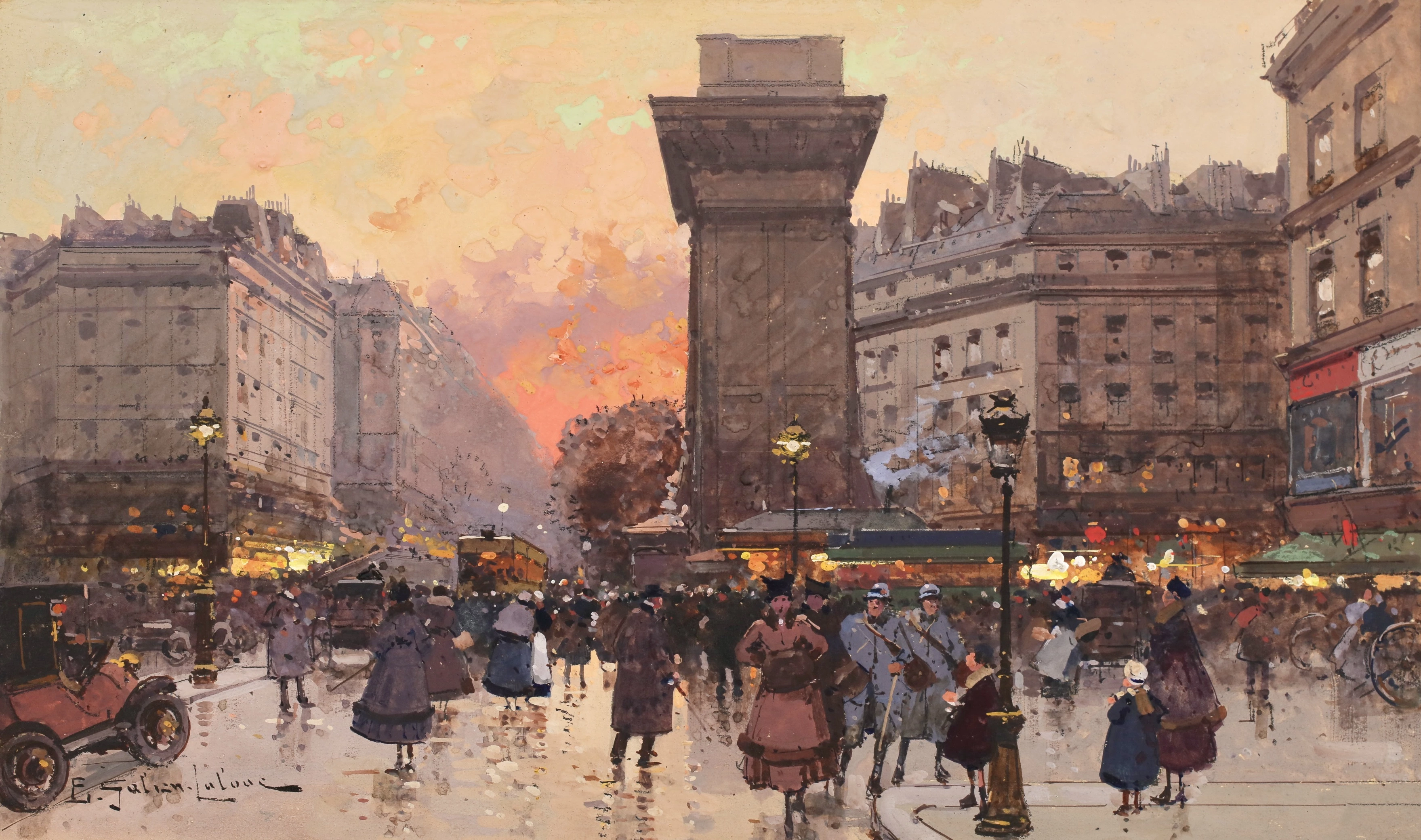
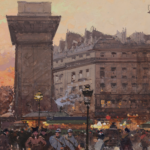
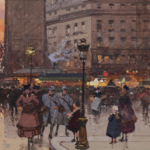
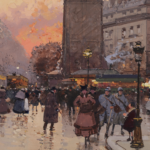
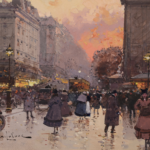
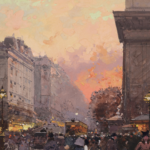
Medium: Gouache on board
Signed: Signed lower left
Size: 8.00" x 13.00" (20.3cm x 33.0cm)
Framed Size: 14.00" x 19.00" (35.6cm x 48.3cm)
Dated: c. 1915
£11,950.00
GBP
Additional information
Condition: Very good condition
Provenance: Private collection - Paris
About this painting
Love the work of Eugene Galien-Laloue?
Sign up to receive notifications when new artworks by Eugene Galien-Laloue are added to our collection.
Eugene Galien Laloue
Eugène Galien-Laloue was a skilled and productive artist. Particularly when working in gouache and producing small-scale works. He painted almost exclusively the most picturesque spots of Paris, notably the Grands-Boulevards. He enjoyed a considerable reputation in the early years of the 20th century. Painting in the happy pre-war period when the city was filled with omnibuses and carriages. His work evokes the atmosphere of turn-of-the-century Paris and retains a documentary value. He also painted landscapes of Normandy, Seine-et-Marne, Marseilles, Italy and Venice. In 1914 he began painting military scenes.
Galien-Laloue is known to have used various pseudonyms, among which were J. Liévin and Liévin. This raises the question of whether the painter Jacques Liévin, to whom paintings on the same themes as those of Eugène Galien-Laloue have been attributed, was also merely a pseudonym of the latter. Jacques Liévin is said to have studied under Léon Germain Pelouse in the early years of the 20th Century. While Galien-Laloue is believed to have studied under one Charles Laloue. However, no evidence of the existence of Charles Laloue has been found. To add to the mystery, while Galien-Laloue was mainly a watercolourist and gouache painter, Jacques Liévin worked mainly in oil. It is, therefore, possible that Galien-Laloue used this false identity specifically for his oil paintings.
Whether or not Jacques Liévin was real, the museums of La Rochelle, Mulhouse and Louviers attribute the following paintings - very reminiscent of Galien-Laloue's style - to him: Place de la République, Paris; Banks of the Seine; Quai Voltaire, Paris; Pont-Royal; Evening, Place de la Concorde; Oats at Angerville; Corn in Beauce.
Meanwhile, Eugene Galien Laloue exhibited under his own name from 1877 at the Salon des Artistes Français in Paris.
La Rochelle (MBA): Place de la République, Paris (gouache signed Liévin); Banks of the Seine - Quai Voltaire, Paris (gouache signed Liévin)
Louviers (Mus. municipal)
Mulhouse
More on the French Impressionists.
Response in
3 Hours
Our specialist team aims to respond to all inquiries within 3 hours during our opening hours.


Client Satisfaction
Guarantee
Boasting over 200 five-star reviews across Google, 1stDibs, and REVIEWS.io.

Platinum
Seller
Recognized as an experienced seller who consistently exceeds customer expectations.
Member since 2016 with over 100 five-star reviews.
Two Decades
of Expertise
Leighton Fine Art brings over two decades of experience in the fine art industry.
Share on social media


