
Achille Laugé

( 1861 - 1944 )

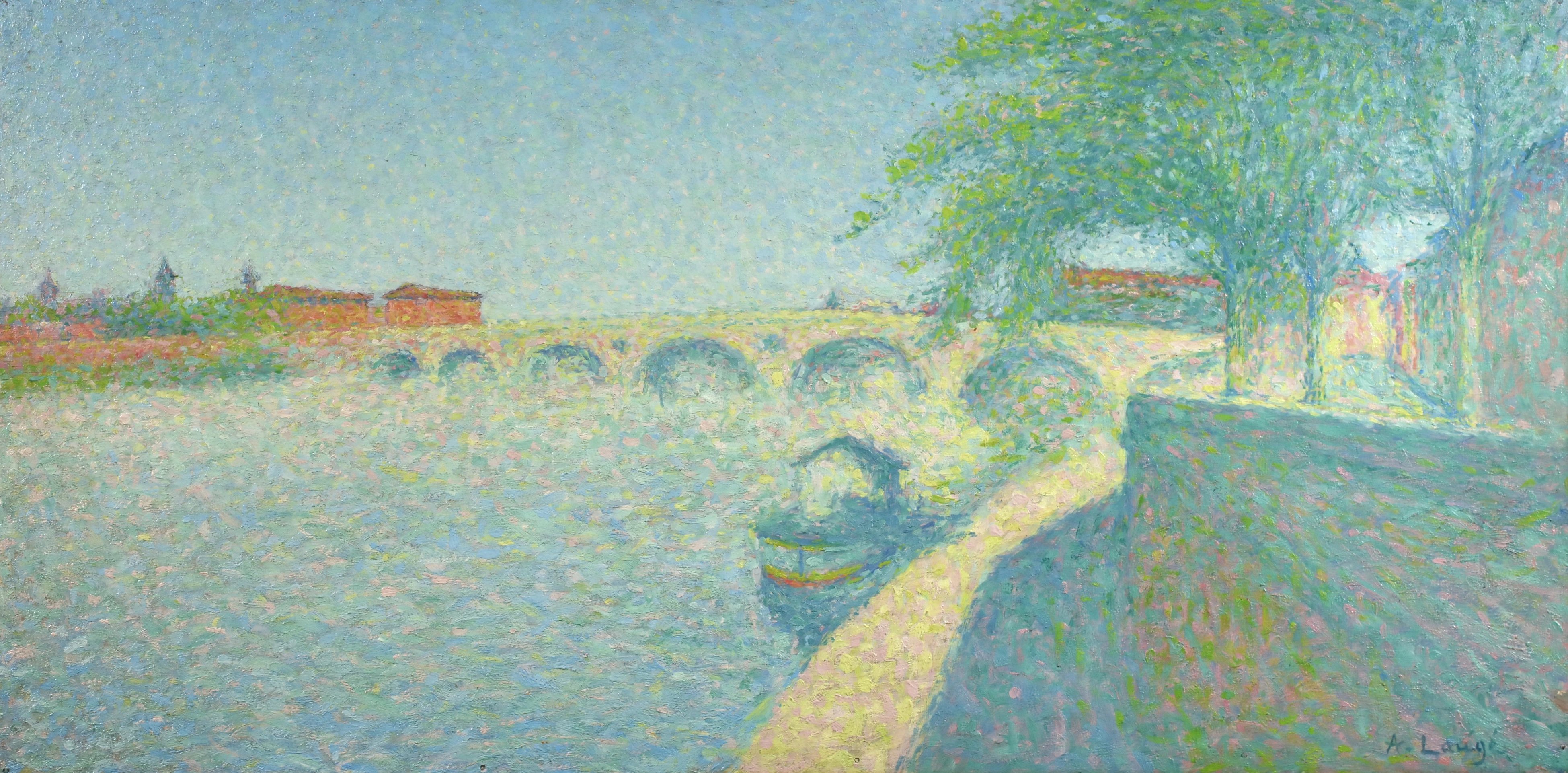
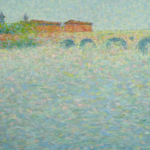
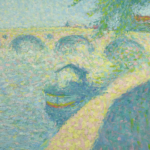
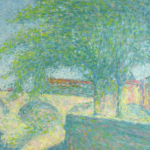
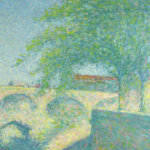
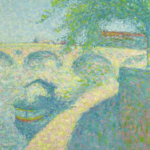
Le Pont Saint Michel – Toulouse

Achille Laugé

( 1861 - 1944 )

Le Pont Saint Michel – Toulouse

  • Medium: Oil on panel

  • Signed: Signed lower right

  • Size: 20.00" x 40.00" (50.8cm x 101.6cm)

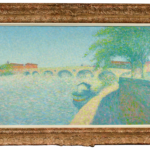
  • Framed Size: 26.00" x 46.00" (66.0cm x 116.8cm)

  • Dated: 1916

£44,000.00
GBP

Image download 1Image download 2Image download 3Image download 4Image download 5Image download 6Image download 7Image download 8Image download 9Image download 10Image download 11Image download 12Image download 13 Download all Images

Additional information

  • Condition: Very good condition

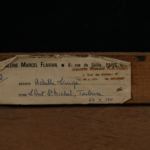
  • Provenance: Galerie Marcel Flavian - Paris (labels verso) c. 1980
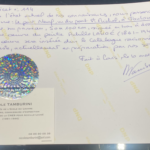
    This work is accompanied by a photo certificate from Mme. Nicole Tamburini and will be included in the forthcoming raisonne of the work of Achille Lauge under preparation by Mme. Tamburini under certificate reference number 114

About this painting

The Pont Saint-Michel in Toulouse — the old stone bridge crossing the Garonne in the heart of the city where Laugé first came to study as a young man — is a subject of deep personal significance as much as painterly interest. Achille Laugé (1861–1944) was born in the Aude, spent his formative years in Toulouse, and returned to the south permanently after seven years in Paris. The Garonne, the light of the Languedoc, the particular warmth of southern French stone — these were his native materials, and he spent a lifetime learning to render them with complete precision. By 1916 Laugé had moved well beyond the meticulous Divisionist dots of his early career and the crosshatching of his middle period into something freer and more physically immediate — broader strokes, thicker paint, a handling that has the directness of traditional Impressionism but informed by two decades of thinking carefully about how colour actually works on a canvas. The light of the Garonne in this painting is built from strokes placed with confidence rather than calculation, each one carrying its full weight of colour without hesitation. The result is a work of remarkable warmth and vitality — the south rendered not as scientific experiment but as felt experience. His friends and contemporaries included Aristide Maillol, with whom he shared a Paris studio, and Antoine Bourdelle. He exhibited at the Salon des Indépendants in 1894 alongside Bonnard, Toulouse-Lautrec and Vuillard. In 1968 he was included in the landmark exhibition of Neo-Impressionism at the Guggenheim Museum in New York. His work is held in the Musée d'Orsay, the Musée National d'Art Moderne at the Centre Pompidou, the Musée Fabre in Montpellier and the Indianapolis Museum of Art.

Be the First to Know

Love the work of Achille Laugé?

Sign up to receive notifications when new artworks by Achille Laugé are added to our collection.

    Achille Laugé Biography

    View full artist profile

    Achille Laugé was born the same year as Bourdelle and Maillol, who would later become his friends. He trained to be a pharmacist in Toulouse, according to his parents' wishes, but also studied at the École des Beaux-Arts, where he met Bourdelle. In 1881 he was admitted to the École des Beaux-Arts in Paris to study in the studio of Alexandre Cabanel and Jean-Paul Laurens, where he met Maillol. He gave lodging to Bourdelle and did his military service in Paris. He left Paris in 1888 and from 1889 had a studio in Carcassonne, where he formed numerous friendships. Two years after the death of his wife, whom he had married in Cailhau in 1891, he himself died: the same year as Maillol.

    By the time he left Paris, Laugé had adopted the Divisionist touch championed by the Neo-Impressionists, and adhered to it more or less closely throughout his career. From 1905, in order to paint in situ, he procured a studio-caravan. For several years from 1916 onwards he had a base in Alet (Aude) and from 1926 spent the summer months in Collioure. From 1932 he had a studio in Paris and lived next door to his friend Bourdelle. In 1913 and 1926 he produced tapestry designs in response to commissions from the Gobelins tapestry manufactory.

    Laugé exhibited three paintings in Paris at the 1894 Salon des Indépendants and the same year featured in an exhibition alongside Bonnard, Maurice Denis, Sérusier, Roussel, Toulouse-Lautrec and Vuillard in Toulouse. In 1900 a large composition by him was rejected by the Société Nationale des Beaux-Arts, and in 1908 he was rejected by the Salon d'Automne. Laugé had his first solo exhibition in Paris in 1907, followed by many others (1911, 1919, 1923, 1927, 1929, 1930). He also showed collections of his works in 1926 in Toulouse and Perpignan. In 1968 he featured in the exhibition on Neo-Impressionism at the Guggenheim Museum in New York. Other retrospective exhibitions took place at the following: the Musée de Limoux (1958); the Musée des Grands-Augustins in Toulouse (1961); London (1966); New York (1967); London (1968); and Paris (1969).

    Museum and Gallery Holdings

    Carcassonne (MBA)
    Limoux (Mus. Petiet)
    Montauban (Mus. Ingres)
    Montpellier (Mus. Fabre)
    Paris (MNAM-CCI)
    Perpignan (Mus. Hyacinthe-Rigaud)
    Toulouse (MBA, Mus. des Augustins)

    Response in
    3 Hours

    Our specialist team aims to respond to all inquiries within 3 hours during our opening hours.

    Google Logo REVIEWS.io Logo

    Client Satisfaction
    Guarantee

    Boasting over 200 five-star reviews across Google, 1stDibs, and REVIEWS.io.

    1stDibs Logo

    Platinum
    Seller

    Recognized as an experienced seller who consistently exceeds customer expectations.

    Member since 2016 with over 100 five-star reviews.

    Two Decades
    of Expertise

    Leighton Fine Art brings over two decades of experience in the fine art industry.

    Share on social media

    A2A - Logo Facebook - Logo Facebook Messenger - Logo X - Logo LinkedIn - Logo Email - Logo WhatsApp - Logo