Further Images
| Medium | Oil on panel |
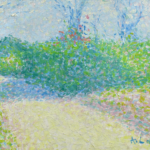
| Signed | Signed lower right |
| Size | 21.00" × 29.00" (53.3cm × 73.7cm) |
| Framed Size | 28.00" × 36.00" (71.1cm × 91.4cm) |
| Dated | c. 1910 |
| Condition | Very good condition |
| Provenance | Galerie Valle de L'Oise Private collection - Paris |
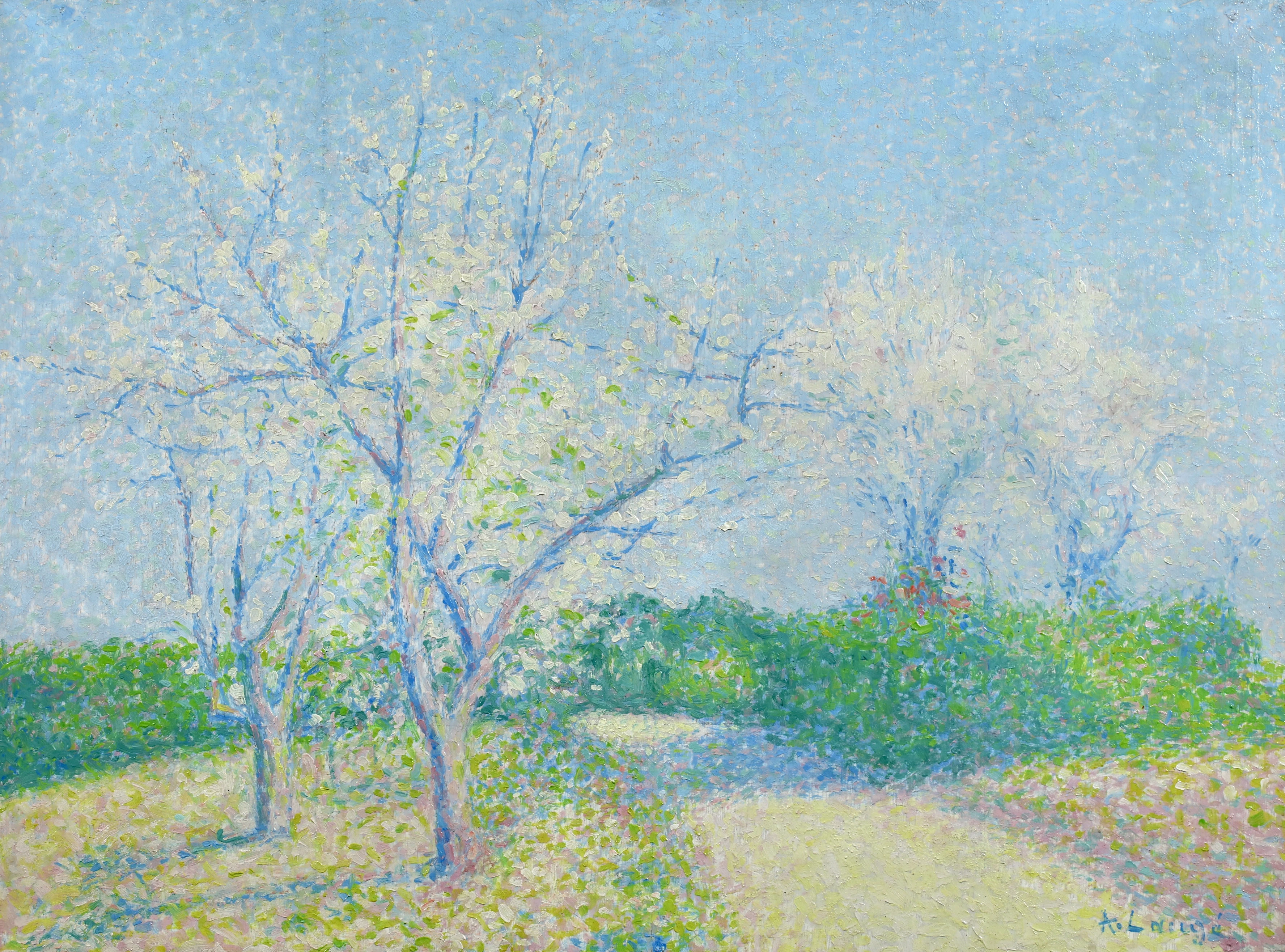
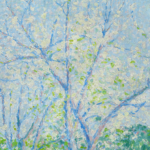
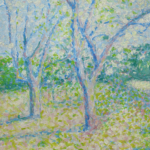
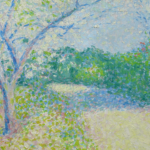
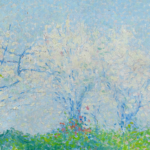
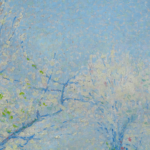
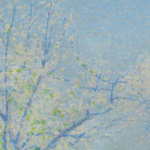
| About this Painting | Fruit trees in blossom against a pale blue spring sky, two in the foreground and others receding to the right above a green hedge, with a sandy path running through the middle distance. The whole is painted in the divided manner Laugé made his own: small separate touches and short crossed hatchings of pure colour laid side by side, the blossom built from creamy white and pale yellow with flecks of green leaf just breaking, the branches and trunks drawn not in brown but in blue and rose, so that they read as objects seen in full light rather than as silhouettes. The foreground is a carpet of yellow, pink, green and lilac strokes; the sky itself is broken into hundreds of small marks so that it vibrates rather than sits flat. Nothing in the picture is a local colour — everything is light. Laugé was born at Arzens in the Aude, studied at Toulouse alongside Bourdelle and Henri Martin and then at the École des Beaux-Arts in Paris under Cabanel and Jean-Paul Laurens, where he shared a studio with Maillol. Seeing Seurat's Grande Jatte at the Indépendants in 1886 was the decisive event of his life. He returned to the Aude, settled at Cailhau in 1895, and spent the rest of his career there as "the hermit of Cailhau", painting the roads, orchards and gardens around his house in series, as Monet painted his cathedrals. From 1896 he worked in a personal divisionism of crossed hatchings. His work is in the Musée National d'Art Moderne, the Louvre, the National Gallery of Art in Washington, and the Musée des Beaux-Arts de Carcassonne, which holds the largest group. The Fondation de l'Hermitage in Lausanne gave him a major retrospective in 2022. |
£55,000.00
GBP