Love the work of Moise Kisling?
Sign up to receive notifications when new artworks by Moise Kisling are added to our collection.
Moise Kisling Paintings
Moïse Kisling was one of the defining figures of the École de Paris, the cosmopolitan community of largely foreign-born artists who made Montparnasse the centre of the Western art world in the years on either side of the First World War. Polish by birth, French by adoption, he became both a fixture of that bohemian milieu and the author of an instantly recognisable body of work — polished, sensuous and quietly classical — that has held a strong and steady market for a century.
He was born in Kraków in January 1891, then part of Austria-Hungary, to a Jewish family, and trained at the city’s Academy of Fine Arts under Józef Pankiewicz, who urged his gifted pupil towards Paris. In 1910, at nineteen, Kisling made the move that would shape his life, settling first in Montmartre and soon afterwards in Montparnasse, just as that quarter was becoming the crucible of modern art. He fell in at once with the most remarkable circle of his generation: Amedeo Modigliani, who painted him more than once and with whom he was especially close; Jules Pascin, Chaïm Soutine, Max Jacob and Jean Cocteau, and, in the wider orbit, Picasso, Braque and Juan Gris. Gregarious and generous, his studio a perpetual gathering point, Kisling is as good a candidate as any to stand at the centre of the Montparnasse legend.
When war came in 1914 he volunteered for the French Foreign Legion, and in 1916 he was gravely wounded at the Somme — an injury that earned him French citizenship in recognition of his service. That same year he married Renée Gros, with whom he had two sons.
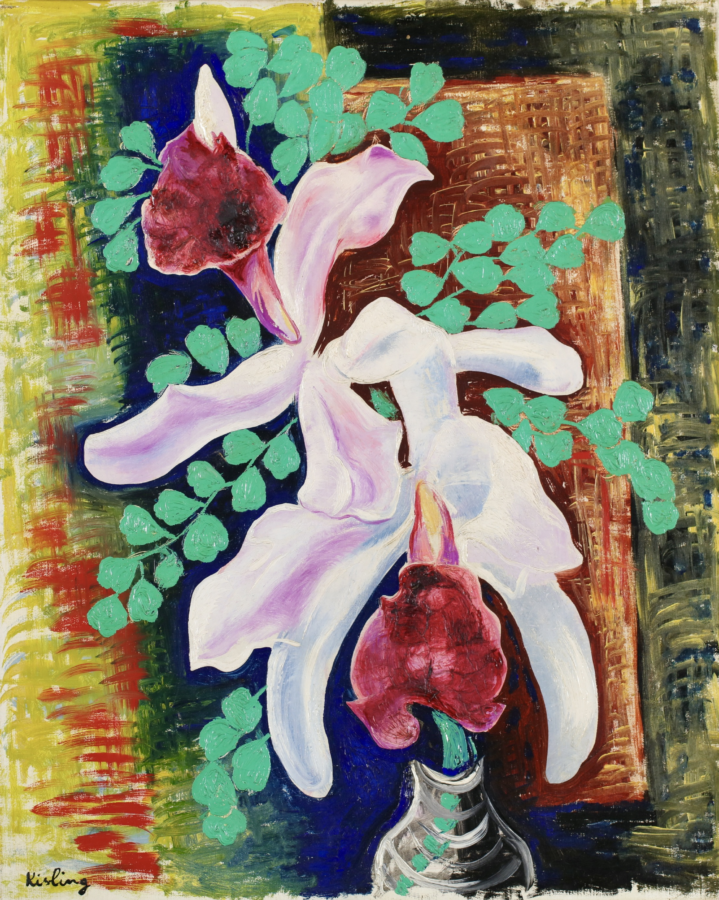
Stylistically, Kisling stands apart from the wilder expressionists among whom he moved. Where Soutine’s surfaces churn, Kisling’s are smooth, controlled, almost enamelled — built on firm drawing and a clarity of contour that betrays his academic grounding and an early study of Cézanne and Derain. His subjects are consistent and immediately legible: reclining nudes, sleek and almond-eyed; poised portraits of women; lush flower pieces, often held tightly to the vertical axis of the canvas; and the bright, high-keyed landscapes of the Midi around Sanary-sur-Mer and Saint-Tropez. It is this marriage of modern subject and classical poise that makes a Kisling recognisable across a crowded room.
Commercially he was one of the genuine successes of his generation, selling well through the 1920s when many of his friends were destitute, and his reputation as the “Prince of Montparnasse” rested on real demand. The Nazi occupation forced a second upheaval: as a Jewish artist under threat, he left France in 1940 for the United States, dividing his time between New York and Southern California, exhibiting at the Whitney Museum of American Art and the Barnes Foundation. With the defeat of Germany he returned to the south of France, painting until his death at Sanary-sur-Mer in April 1953.
The essential scholarly tool is the catalogue raisonné under preparation by the artist’s son, Jean Kisling, with Joseph Kessel (Kisling, Harry N. Abrams, from 1971) and Marc Ottavi , organised by subject across several volumes. A century on, he endures for the same reasons he succeeded in life: technically assured, decoratively irresistible, and inseparable from one of the most romanticised moments in modern art.
Selected public collections holding his work:
Moise Kisling Paintings
© 2026 Leighton Fine Art Ltd. All rights reserved.
Registered in England & Wales · 08072141 · Terms & Conditions