
Moise Kisling

( 1891 - 1953 )

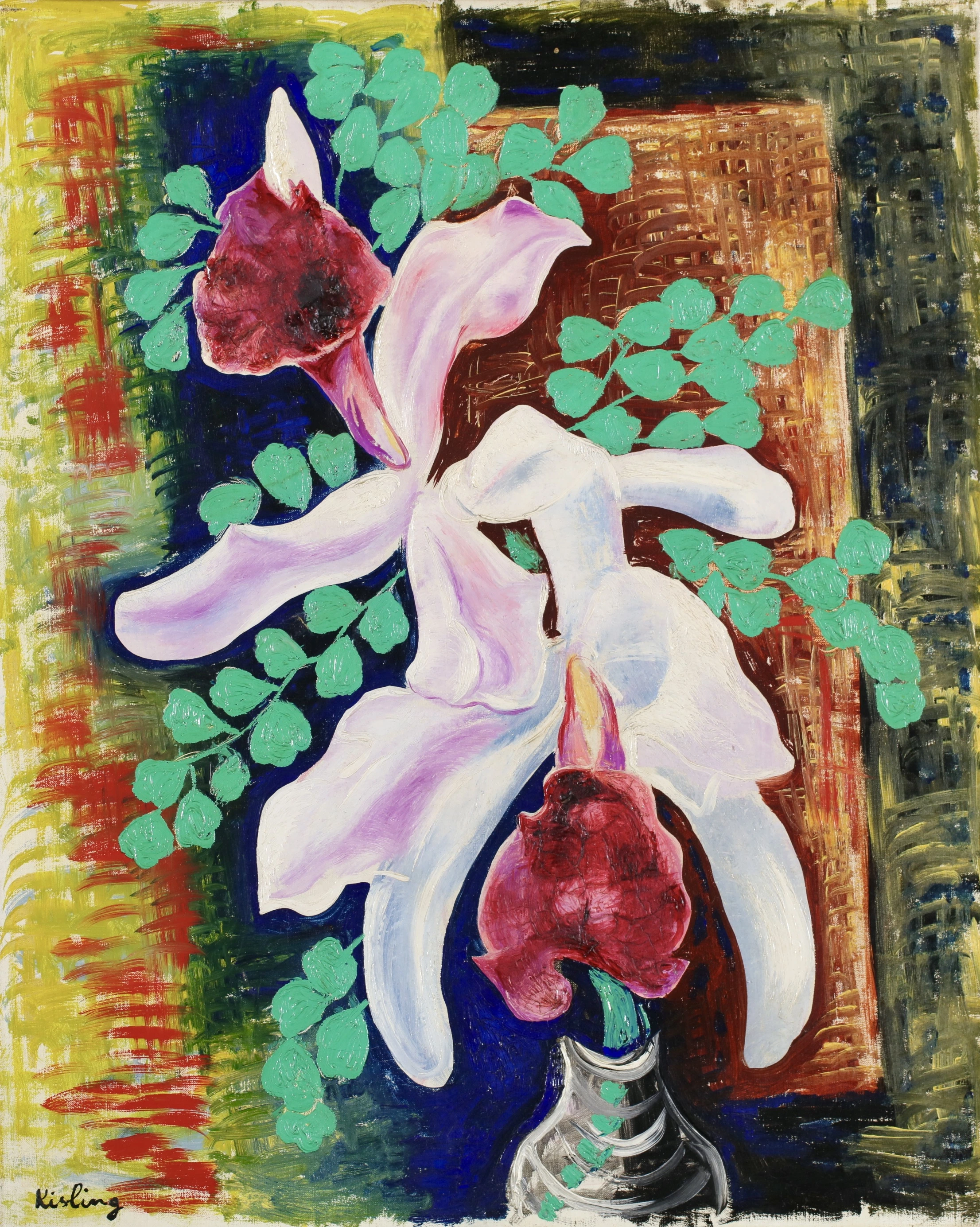
Les Orchidées

Moise Kisling

( 1891 - 1953 )

Les Orchidées

  • Medium: Oil on canvas

  • Signed: Signed lower left

  • Size: 16.00" x 13.00" (40.6cm x 33.0cm)

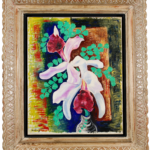
  • Framed Size: 23.00" x 20.00" (58.4cm x 50.8cm)

  • Dated: 1930

£55,000.00
GBP

Image download 1Image download 2Image download 3Image download 4Image download 5Image download 6Image download 7Image download 8Image download 9Image download 10 Download all Images

Additional information

  • Condition: Very good condition

  • Provenance: Wally Findlay Galleries - Palm Beach, Florida 1975
    Alan Klinkhoff Gallery - Montreal, Canada
    This work has been authenticated by Jean Kisling and will be included in the forthcoming catalogue raisonne of the work of Moise Kisling. Jean Kisling is the co-author of the 'Catalogue Raisonné de l’Oeuvre de Moïse Kisling' currently being prepared with Marc Ottavi.

  • Literature: This work is illustrated in "Moïse Kisling" (New York : Harry N. Abrams, 1971) No. 197

About this painting

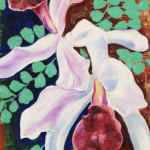
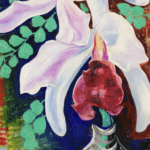
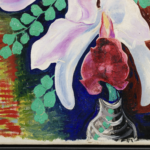
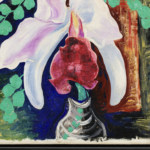
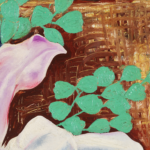
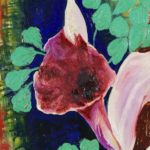
A sumptuous still life of orchids by Moïse Kisling, one of the leading painters of the École de Paris, dating from 1930 — a period widely regarded as the height of his artistic maturity. Three luxuriant cattleya blooms — their broad white and lavender petals unfolding around deep crimson lips — cascade from a glass vase, framed by delicate sprays of maidenhair fern. The background is a rich tapestry of colour: deep ultramarine blue behind the flowers, a panel of woven cane to the right, and bold passages of red, yellow, and dark green worked in vigorous crosshatched brushstrokes that give the composition a powerful decorative energy. The painting demonstrates the qualities that made Kisling's flower pieces so sought after — a boldness of colour inherited from the Fauves, a sensuality of form that he brought to everything he painted, and a decorative confidence that transforms a simple floral subject into something close to abstraction. The orchids themselves are handled with a fluid, almost sculptural touch, their petals modelled in soft pinks and whites that glow against the intensity of the surrounding colour. Born in Kraków and settled in Paris from 1910, Kisling was a central figure of the Montparnasse avant-garde alongside Modigliani, Soutine, Chagall, and Pascin. By 1930 he was at the peak of his international reputation, exhibiting widely and collected by major galleries on both sides of the Atlantic. His work is held in museum collections worldwide. This work was sold by the Wally Findlay Galleries in Palm Beach in 1975 and is recorded in the monograph "Moïse Kisling",written by Harry N. Abrams.

Be the First to Know

Love the work of Moise Kisling?

Sign up to receive notifications when new artworks by Moise Kisling are added to our collection.

    Moise Kisling Biography

    View full artist profile

    Moïse Kisling was one of the defining figures of the École de Paris, the cosmopolitan community of largely foreign-born artists who made Montparnasse the centre of the Western art world in the years on either side of the First World War. Polish by birth, French by adoption, he became both a fixture of that bohemian milieu and the author of an instantly recognisable body of work — polished, sensuous and quietly classical — that has held a strong and steady market for a century.

    He was born in Kraków in January 1891, then part of Austria-Hungary, to a Jewish family, and trained at the city's Academy of Fine Arts under Józef Pankiewicz, who urged his gifted pupil towards Paris. In 1910, at nineteen, Kisling made the move that would shape his life, settling first in Montmartre and soon afterwards in Montparnasse, just as that quarter was becoming the crucible of modern art. He fell in at once with the most remarkable circle of his generation: Amedeo Modigliani, who painted him more than once and with whom he was especially close; Jules Pascin, Chaïm Soutine, Max Jacob and Jean Cocteau, and, in the wider orbit, Picasso, Braque and Juan Gris. Gregarious and generous, his studio a perpetual gathering point, Kisling is as good a candidate as any to stand at the centre of the Montparnasse legend.

    When war came in 1914 he volunteered for the French Foreign Legion, and in 1916 he was gravely wounded at the Somme — an injury that earned him French citizenship in recognition of his service. That same year he married Renée Gros, with whom he had two sons.

    Stylistically, Kisling stands apart from the wilder expressionists among whom he moved. Where Soutine's surfaces churn, Kisling's are smooth, controlled, almost enamelled — built on firm drawing and a clarity of contour that betrays his academic grounding and an early study of Cézanne and Derain. His subjects are consistent and immediately legible: reclining nudes, sleek and almond-eyed; poised portraits of women; lush flower pieces, often held tightly to the vertical axis of the canvas; and the bright, high-keyed landscapes of the Midi around Sanary-sur-Mer and Saint-Tropez. It is this marriage of modern subject and classical poise that makes a Kisling recognisable across a crowded room.

    Commercially he was one of the genuine successes of his generation, selling well through the 1920s when many of his friends were destitute, and his reputation as the "Prince of Montparnasse" rested on real demand. The Nazi occupation forced a second upheaval: as a Jewish artist under threat, he left France in 1940 for the United States, dividing his time between New York and Southern California, exhibiting at the Whitney Museum of American Art and the Barnes Foundation. With the defeat of Germany he returned to the south of France, painting until his death at Sanary-sur-Mer in April 1953.

    The essential scholarly tool is the catalogue raisonné under preparation by the artist's son, Jean Kisling, with Joseph Kessel (Kisling, Harry N. Abrams, from 1971) and Marc Ottavi , organised by subject across several volumes.  A century on, he endures for the same reasons he succeeded in life: technically assured, decoratively irresistible, and inseparable from one of the most romanticised moments in modern art.

    Selected public collections holding his work:

    • Musée du Petit Palais, Geneva (the most significant single holding)
    • Metropolitan Museum of Art, New York
    • Harvard Art Museums, Cambridge, Massachusetts
    • Tokyo Fuji Art Museum, Japan
    • Ikeda Museum of 20th Century Art, Japan
    • Israel Museum, Jerusalem

    Response in
    3 Hours

    Our specialist team aims to respond to all inquiries within 3 hours during our opening hours.

    Google Logo REVIEWS.io Logo

    Client Satisfaction
    Guarantee

    Boasting over 200 five-star reviews across Google, 1stDibs, and REVIEWS.io.

    1stDibs Logo

    Platinum
    Seller

    Recognized as an experienced seller who consistently exceeds customer expectations.

    Member since 2016 with over 100 five-star reviews.

    Two Decades
    of Expertise

    Leighton Fine Art brings over two decades of experience in the fine art industry.

    Share on social media

    A2A - Logo Facebook - Logo Facebook Messenger - Logo X - Logo LinkedIn - Logo Email - Logo WhatsApp - Logo