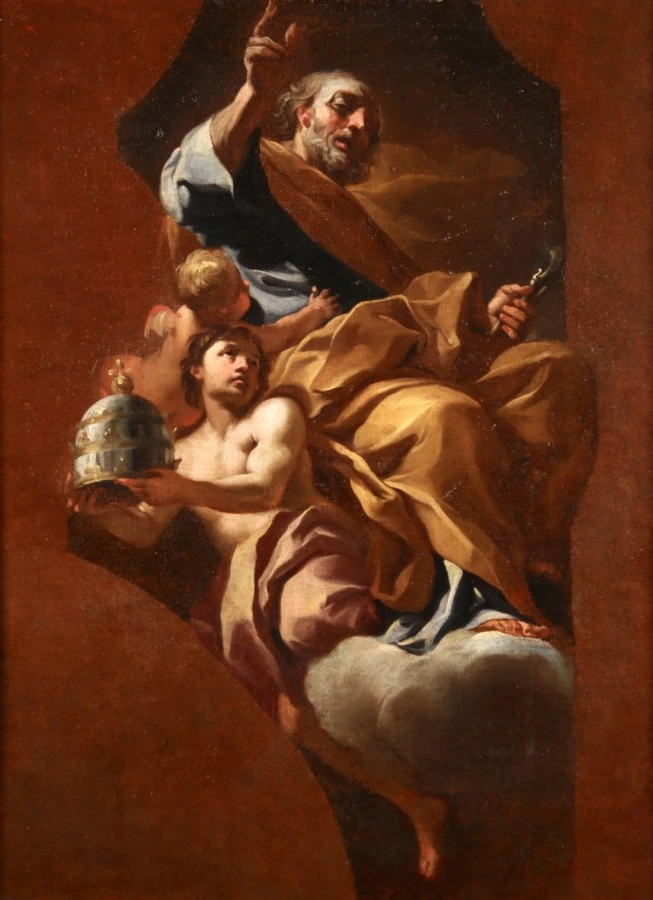
Love the work of Francesco Solimena?
Sign up to receive notifications when new artworks by Francesco Solimena are added to our collection.
Francesco Solimena Paintings
Francesco was the son and pupil of Angelo Solimena. Initially, his father wanted to steer him towards the study of literature, but thanks to the intervention of Cardinal Orsini, later Pope Benedict XIII, Francesco was allowed to give his enthusiasm for painting free rein. After two years’ study with his father, he went in 1674 to Naples to work with Francesco di Maria, then with Giacomo del Po. He continued his studies in Rome, copying the works of Pietro da Cortona, Guido Reni and Carlo Maratti.
He worked at the churches of S Maria Donna Regina in 1684 and S Paolo Maggiore in 1689. Between 1697 and 1708 he took part in the monumental decorative works at the abbey at Montecassino, where he executed frescoes for two chapels and four major canvases for the chancel. In 1708, he received a commission for three paintings for the Senate chamber in Genoa, executed between 1715 and 1717; these paintings were destroyed in 1777, but a number of preparatory sketches survive. Although most of his working life was spent in Naples, he also visited Spain, where Philip V asked him to execute several paintings for the royal chapel in Madrid, and made two trips to Rome, where he painted his celebrated Heliodorus Driven from the Temple (1725) at the church of Gesù Nuovo. An outstanding Baroque artist, Solimena was first inspired by the style of Luca Giordano, to which he brought a solidity and more dramatic contrastive effects. While Luca Giordano’s Madonna del Baldacchino is an insubstantial work, Solimena’s Virgin and Child with SS Peter and Paul, constructed on the same principles of composition, is a more dramatic work in which contrast is used to accentuate form clearly. These dramatic luminous effects are undoubtedly borrowed from Preti, while Solimena’s perspectival effects derive from the style of Lanfranc. Solimena’s work might therefore be said to be a true synthesis of all the elements in the Neapolitan Baroque, merged in luminous scenography. In his mature work, he continued in the measured rhythm of the Baroque, fiercely resisting the Rococo and leaning towards more academic painting. He exerted considerable influence on painters in subsequent generations, both in Naples and in Europe as a whole, and he and Luca Giordano ushered in the era of 18th-century Neapolitan art with their respective decorative works in the Cappella del Tesoro in S Martino. He was also a poet, architect and musician.
Collective thematic exhibitions in which his work has featured include Celestial Glories ( Cieux en gloire) at the Fesch museum in Ajaccio in 2002, an evocation of the great Roman decorative commissions during the Baroque period using sketches (‘bozzetti’ and ‘modelli’), and The Mysteries of Naples. The Sublime and the Trivial: Neapolitan Painting. Angelo and Francesco Solimena: Two Cultures Compared ( Angelo e Francesco Solimena: due culture a confronto), featuring works by both father and son, was mounted in 1990 at the Convento di Sant’Anna at Nocera Inferiore.
Museum and Gallery Holdings
Ajaccio (Mus. Fesch): Departure of Rebecca (oil on canvas)
Amiens: St John the Baptist Preaching in the Desert
Angers: Annunciation
Avignon: Bronze Serpent
Besançon: Godefroy de Bouillon Wounded
Béziers: Coronation of the Virgin
Bonn: Paradise
Bordeaux: Joseph Interpreting Dreams in Prison
Caen: Death of Archimedes
Chambéry (MBA): Descent from the Cross
Cherbourg: Jacob’s Ladder
Compiègne: Portrait of a Man; Rough Sketch
Dijon: Death of St Joseph; Assumption
Dresden: Centaurs and Lapiths in Combat; Virgin and Infant Jesus in the Clouds; Angel with Violin Appearing to St Francis; Mater Dolorosa; Sophonisba Receiving Poison from her Husband’s Messengers; Juno and Io Turned into a Cow; Abduction of Women
Florence: The Artist; Diana Bathing with her Nymphs
Glasgow: Justice and Peace
Hanover: St Thomas Aquinas; Know Thyself (allegory)
La Fère: Death of the Virgin
Le Havre: Simon the Magician
Le Puy-en-Velay: Baptism of Jesus
Lille: Legend of St Thomas Aquinas
London (NG): An Allegory of Louis XIV (c. 1700, oil on canvas, sketch); Dido receiving Aeneas and Cupid disguised as Ascanius (1720s, oil on canvas)
Madrid (Prado): Prometheus in Chains in the Caucasus; St John the Baptist; Portrait of a Man; Portrait of the Artist; St Joachim and St Anne
Marseilles: Christ on the Cross
Milan (Pinacoteca di Brera): St Leo on his Way to Meet Attila; Conference of the Order of St Benedict
Montauban: Allegory of Life
Moscow (Rumiantsev Mus.): St Martin Giving his Garments to Beggars; Philogeniture
Mulhouse: Assumption
Naples: Portia and Brutus; Death of Virginia; Venus Surrounded by the Divinities of Love; Allegories (two); St Roch; Massacre of the Giustiniani Family; Transfiguration of the Madonna (two); Madonna and Child; Death of Filippo Neri; Vision of Pius V; Expulsion of Heliodorus from the Temple
New Haven (Knights of Columbus Mus.): The Virgin Immaculata or Allegory of Purity
Paris (Louvre): Heliodorus Driven from the Temple
Rohrau (Schlossmus., Graf Harrach’sche Familiensammlung): Virgin, Infant Jesus and St John (two); Virgin and Infant Jesus; Deborah; Christ on a Rock; Veneration of St Januarius; Allegory of Sovereignty
Rome (Gal. Nazionale): Liberation of St Peter; Madonna and Child; Portrait of a Young Man
Rome (Palazzo Doria Pamphili): Personification of Europe, America, Asia and Africa
Rouen: Christopher Columbus Receiving Papal Bulls; St Remigius, Archbishop of Rheims
Salford (Museum and AG): Christ Appearing to Mary Magdalen
Sorrento: Portrait of a Woman
Speyer: Madonna with Child and St John
St Petersburg (Hermitage): Allegory of Religion
Stuttgart (Staatsgal.): Rebecca at the Well
Tarbes: Wise and Foolish Virgins
The Hague: Annunciation
Toulon: Abdication of Charles V; St Benedict Healing the Sick (a sketch)
Toulouse: Portrait of a Woman
Trapani: Assumption
Vatican (Mus. Vaticani): St Michael Vanquishing the Devil
Venice (Gal. dell’Accademia): Rebecca and Eliezer; Jacob and Rebecca
Vienna (Kunsthistorisches Mus.): Emperor Charles VI and Count Gundaker Althann
Vienna (Österreichische Gal. Belvedere): Abduction of Oreithyia; Descent from the Cross
Washington DC (Georgetown University): The Departure of Rebecca (c. 1710, oil on canvas
Francesco Solimena Paintings