Love the work of Ernest Yarrow Jones?
Sign up to receive notifications when new artworks by Ernest Yarrow Jones are added to our collection.
Ernest Yarrow Jones Paintings
British, 1872–1951 — painter, sculptor and illustrator
A Liverpool tea merchant’s son who qualified for the Bar and then gave it up for painting. His formation was largely French, and his finest pictures were made under Mediterranean light.
Liverpool, Wales and the law
Ernest Yarrow Jones was born in Liverpool on 13 July 1872, the son of Edward Jones, a wholesale tea merchant and Justice of the Peace, and his wife Elizabeth Jane. He was brought up between the city and the family’s North Wales home at Groudd, Cerrigydrudion, alongside his siblings Helena, Arthur Edward and Osman Wynne. The animals and landscape he studied as a boy in Wales supplied the subjects he returned to for the rest of his working life.
He was educated at Parkfield School and at Liverpool College Upper School, and matriculated at Pembroke College, Oxford, on 26 October 1891 to read law. He went on to the Inner Temple and qualified as a barrister. Having done so, he abandoned practice altogether and began his career as a painter in about 1899, by then in his late twenties.
Training
Jones studied first at the Westminster School of Art and then at the South Kensington Art School — the institution renamed the Royal College of Art in 1896, which is why both names appear in accounts of his education. Having finished in London, he went to Paris.
France – The Paris Academies
He trained at both the Académie Julian and the Académie Colarossi. Neither was the École des Beaux-Arts. They were the private academies that took foreign students without the École’s entrance examination, and they were where most of the English-speaking colony in Paris actually learned to paint. Colarossi was the cheaper and less formal of the two, admitting women on equal terms with men and running its life classes with far less doctrine than the École imposed. The distinction matters: Jones chose an education that was cosmopolitan and comparatively unorthodox.
Boulevard Arago
He subsequently lived for extended periods at 65 boulevard Arago, in the thirteenth arrondissement. The number falls within the run of timber-framed studios at 61–67 known as the Cité Fleurie — twenty-nine workshops set around a shared garden courtyard, built in part from materials salvaged from the Exposition Universelle of 1878. Over the years its tenants included Gauguin, Modigliani and Munch, and in the years Jones was in residence it housed a genuinely international community of painters and sculptors.
The Salons
From about 1905 he exhibited at the Paris Salons: the Beaux-Arts, the Salon d’Automne and the Salon des Indépendants. The choice of venue is telling. The Indépendants sat no jury at all, and the Salon d’Automne was where the Fauves first showed as a group in 1905, the very year Jones began exhibiting in Paris. He was not one of their number, but he chose to place his work among the progressive salons rather than confine it to the Royal Academy at home.
Corsica and the south
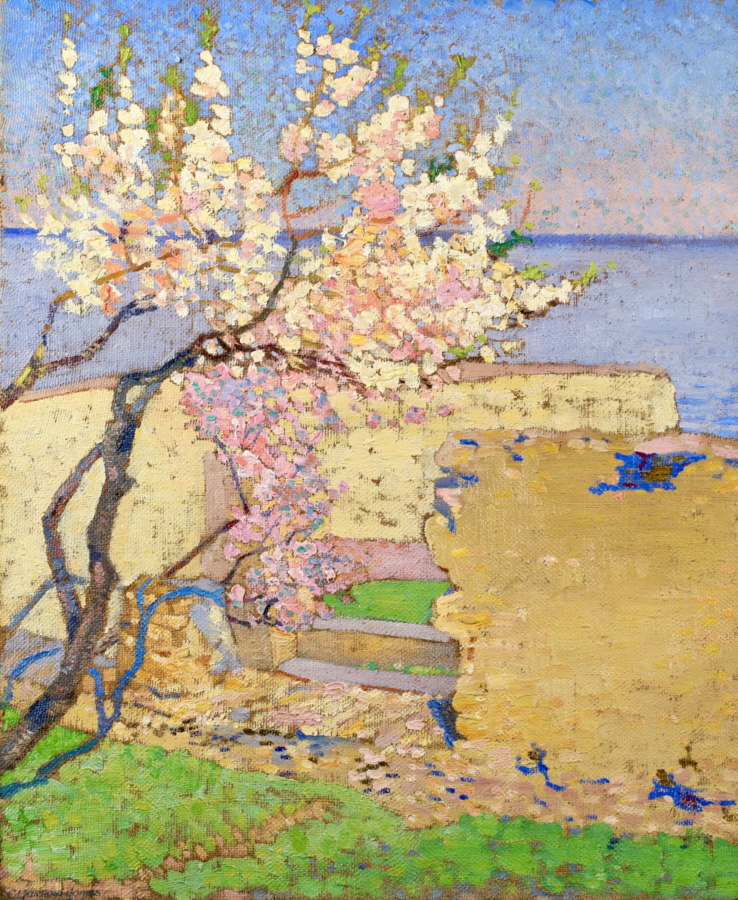
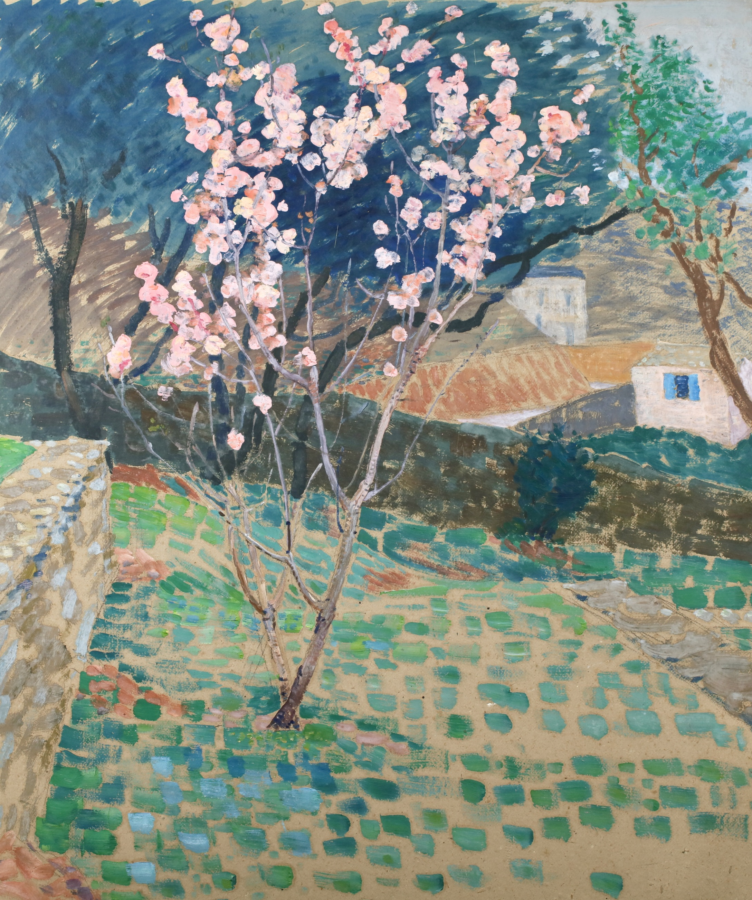
In 1910 he travelled to Corsica and painted the series of blossom studies that remains his best-known body of work. Four years later they were shown at the Leicester Galleries in London under the title Sunshine and Blossoms in Corsica. Recorded pictures from the group include An Almond Tree in Blossom, Corsica and Almond blossom with the mountains beyond, Corsica, painted in oil about 1910.
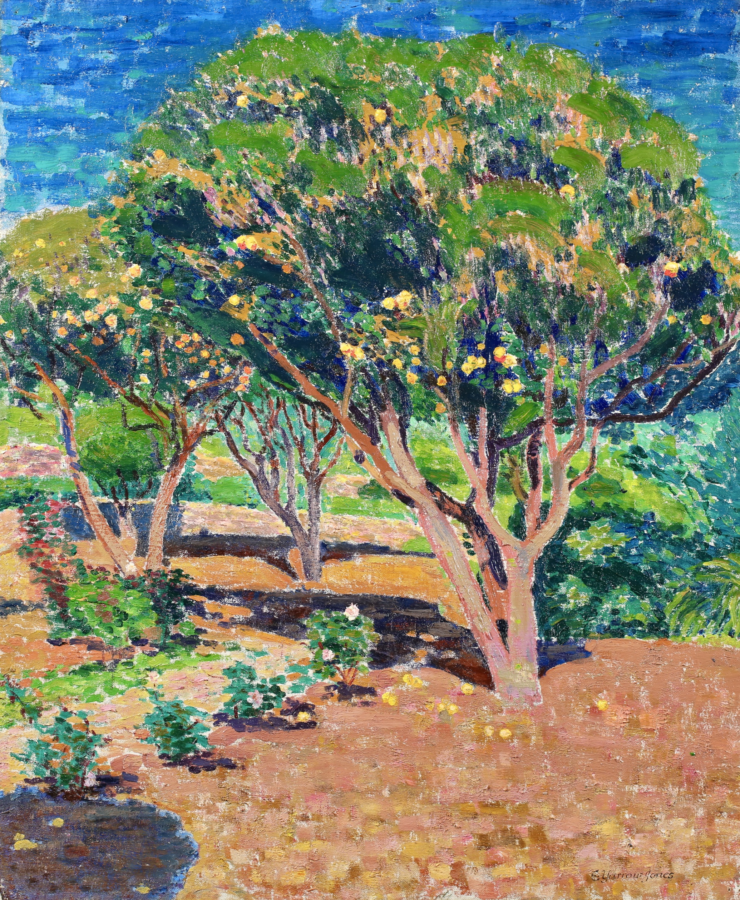
A further title, Orchard at Bormes-les-Mimosas, places him on the Var coast in Provence, between Le Lavandou and Hyères — the same stretch of littoral that Henri-Edmond Cross and Paul Signac had been working a decade earlier. Another of his pictures carries the French title Les Foins.
He married Mary Poulter, a childhood friend, in 1905. Their daughter was named Yvonne Mireille. Mireille is distinctively Provençal: it comes from Mistral’s Mirèio, the poem that anchored the nineteenth-century revival of the Occitan language, and it is not a name an English family reaches for by accident. The southern French attachment evidently ran deeper than a painting tour.
Style and materials
Jones was strongly influenced by Impressionism, and was described as seeking to record the effect of light with great accuracy while keeping form intact — a position closer to the Post-Impressionist settlement than to Impressionism proper, and one that matches how the Corsican blossom pictures are generally catalogued today.
He worked in oil, in watercolour and in sculpture, and also produced illuminated manuscripts. His studio at Black Gable was built for both disciplines at once: north-facing light for the painting, and south-facing doors through which marble could be worked. He signed his pictures E. YARROW JONES in block capitals.
He illustrated as well as painted. The Childhood of Animals appeared in 1912 and Apple of Beauty and Discord in 1920.
Exhibitions, collections and later life
In England Jones exhibited at the Royal Academy, and held solo exhibitions at the Leicester Galleries, the Arlington Gallery and the Macrae Gallery. He and Mary lived at Black Gable in Hythe, Kent, a house built in 1901 by the Arts and Crafts architect Edward Turner Powell and extended in 1909. He later settled at Exmouth in Devon, where he died in 1951.
His work is held in the Ashmolean Museum, Oxford.
Ernest Yarrow Jones Paintings
© 2026 Leighton Fine Art Ltd. All rights reserved.
Registered in England & Wales · 08072141 · Terms & Conditions