Love the work of Charles Palmié?
Sign up to receive notifications when new artworks by Charles Palmié are added to our collection.
Charles Palmié Paintings
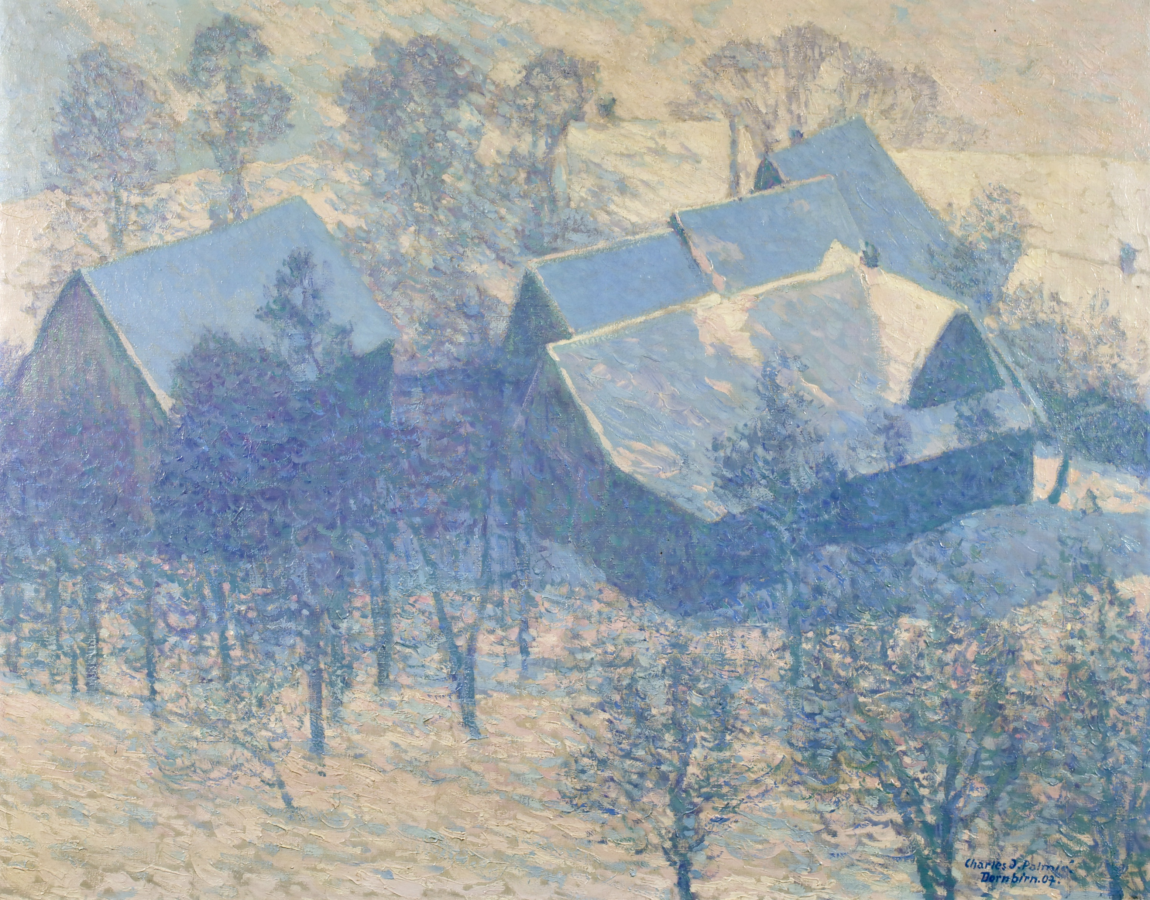
Charles Johann Palmié was among the most gifted German Neo-Impressionists of his generation — a painter who absorbed the lessons of French Impressionism, and of Claude Monet above all, and carried them into the ferment of the early Munich avant-garde. Born at Aschersleben on 22 October 1863, he trained first, from the age of fourteen, as a decorative and theatre painter under the court decorator Rieck in Dresden, and then studied for two years at the Dresden Academy. In 1884 he moved to Munich, completing his education under the landscape painter August Fink, and by 1886 — the year he married the flower painter Marie Kapferer — he was established as an independent artist, his reputation built on exhibitions at the Munich Glaspalast.
Through the 1890s he painted the Alps and the river plains of the Altmühl, the Wörnitz and the Danube, working toward the broad, luminous, neo-impressionist manner that would define him. But the decisive turn came through Monet. In 1904 Palmié saw an exhibition of Monet’s work staged in Munich by Wassily Kandinsky — a revelation that reoriented his art. Enraptured, he travelled to France in 1905, retracing the Impressionists’ steps through Paris, Rouen and Normandy to study neo-impressionism, pointillism and the single-tone painting of the French school. In the summer of 1906 he reached Giverny and painted alongside Monet himself, deepening his grasp of light, atmosphere and the dissolution of form into colour.
The paintings of these years are his finest. Contours give way to an atmospheric whole; the landscape is built from loosely juxtaposed, vibrating dabs of pure colour, so that light itself becomes the subject. The debt to Monet is plain in his treatment of light and his choice of motif — poplar-lined rivers, church spires through trees, gardens and water — while the mosaic-like structure of his touch recalls the divisionism of Signac. Yet Palmié never became a mere follower: his neo-impressionism, as one scholar put it, drew on French principles without submitting to their heavily theoretical demands, and his instinct for balanced composition and vibrant colour is unmatched in German art on the threshold of the modern age.
Back in Munich he became a regular at the salon of Marianne von Werefkin, moving among the leading spirits of the southern-German avant-garde. In 1909 he was a founding member, alongside Kandinsky, Alexej von Jawlensky and Gabriele Münter, of the Neue Künstlervereinigung München (NKVM) — the association that directly prefigured Der Blaue Reiter and the birth of German modernism. His own art stands at exactly that threshold, one foot in the Impressionist garden of Giverny, the other in the coming revolution.
Palmié died suddenly of a stroke in Munich on 15 July 1911, at only forty-seven. Long one of the “famous unknowns” of pre-war Munich, he is now recognised as a pivotal figure — the painter who brought Monet’s light to Germany and helped light the way to the Blaue Reiter.
Charles Palmié Paintings
© 2026 Leighton Fine Art Ltd. All rights reserved.
Registered in England & Wales · 08072141 · Terms & Conditions