
Medium: Oil on canvas laid on panel
Signed: Signed lower left
Size: 14.00" x 10.00" (35.6cm x 25.4cm)
Framed Size: 22.00" x 18.00" (55.9cm x 45.7cm)
Dated: c. 1904
SOLD
Additional information
Condition: Very good original condition
Provenance: Private UK collection
Literature:
With many thanks to Dr Denise Ferran for her expertise and assistance in researching this work. The following essay was submitted by her:
"It was the work of the Impressionists, which most impressed the young artist William John Leech, firstly by his teacher in Dublin, Walter Osborne and then seeing their work in Dublin in the 1899 Loan Exhibition and again in the Parisien galleries of Durand-Ruel. In Paris, he shared a studio in Montparnasse, close to Julian’s, with two New Zealand friends, S.L. Thompson and C. Bickerton. When Thompson had to leave Academie Julian’s in the summer of 1902 because of the heat and the fumes from the oil paint scrapings on the walls, Leech remained at Julian’s for another year but then followed Thompson to Concarneau in 1903, after completing two years at Julian’s. Going to Brittany was a route for French artists such as Gauguin but also for Irish artists before Leech, such as Nathaniel Hone and Walter Osborne. Irish artists, Helen Mabel Trevor, Aloysius O’Kelly, Henry Thaddeus Jones and John Lavery specifically made Concarneau their destination of choice, which after the 1880’s was accessible with the extension of the railway line.
Concarneau, with its harbour and its fishing industry was an attractive location for artists. Willing to pose for a modest fee, the local people brought along their coiffes and collars, the fishermen in their Breton fishing gear, whether they fished for sardines or tuna. S.L.Thompson, who became Leech’s lifelong friend, described the area in 1905 as full of ‘quaint fisherfolk, with their picturesque boats, and in the other villages characteristic types particularly valuable to figurative painters’ which he was. The four hotels in Concarneau were cheap to stay in and Leech stayed in the Hotel de France when he arrived and lodged there, on and off, until 1906. The Hôtel des Voyageurs provided studios for artists in their top floors but Leech most likely shared a studio with Thompson which was along the quayside, with views of the harbour and the markets, the large weekly market being held outside the Hôtel des Voyageurs.
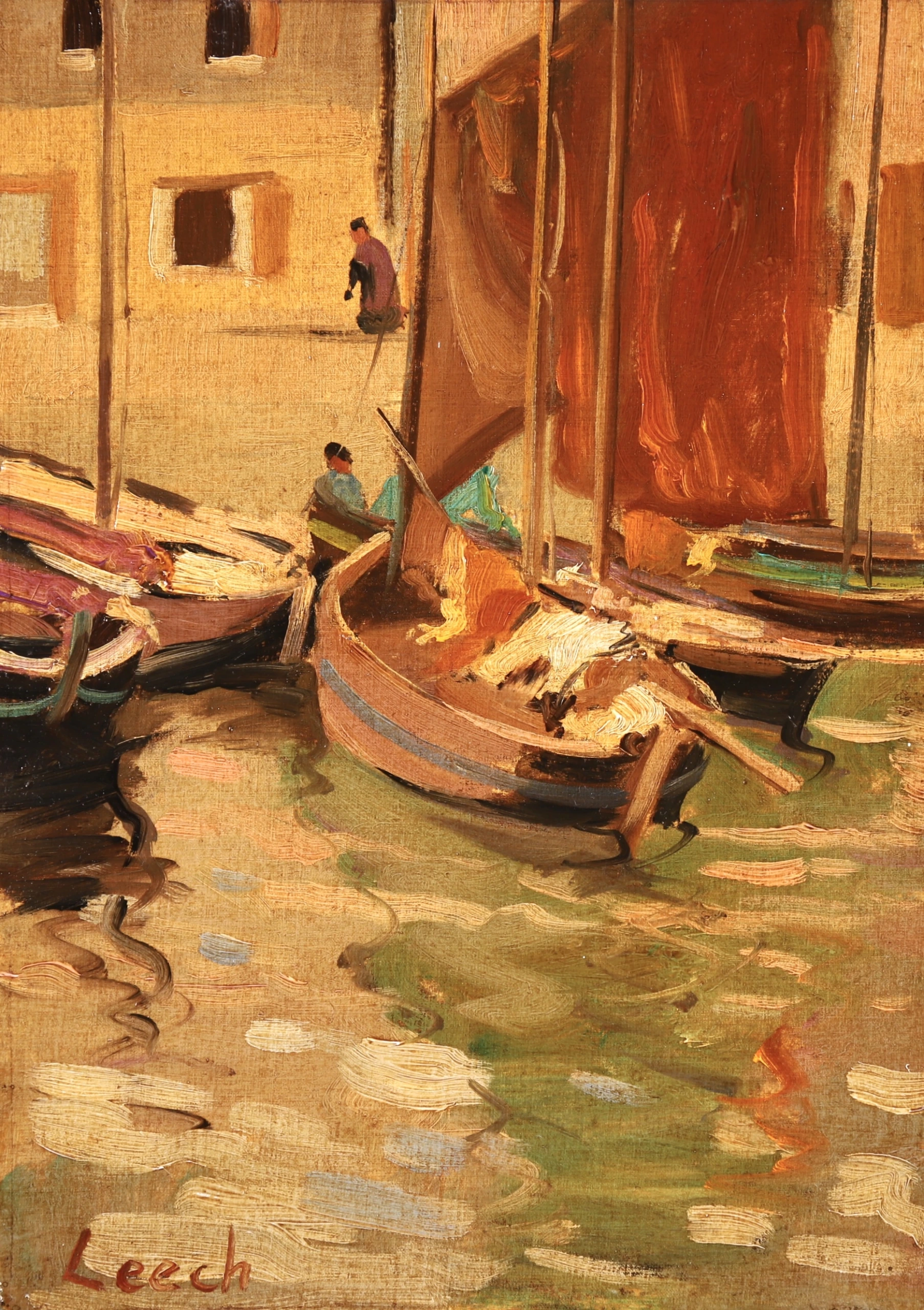
This view of tuna boats moored at the harbour, with some of the sails collapsed whilst another has its characteristic reddish brown canvas sails, still unfurled, was a favourite subject of Leech’s. All the tuna boats used the same blood red dye for their sails to distinguish them from the sardine fishing boats with their blue sails. A fisherman, with black beret, works with nets at the side of the boat while a Breton women in traditional gear, with her long skirts and aprons and her hair tucked back into a traditional black hat, walks up the slipway from the boats to the houses surrounding the quayside. This is a characteristic, en plein air Leech, which he produced in his early years in Concarneau, many of these he exhibited in Dublin, in the Leinster Lecture Hall in 1907, introduced by Constance Gore Booth, Countess Markievicz, which gave Leech the opportunity to exhibit a larger body of work. The critic, writing in the Irish Times, August 26th 1907, describes these works as “the majority of Mr Leech’s pictures are small sketches done direct from nature en plein air. They are composed in a key of low tones of colour, treated with absolute directness and laid on in a series of blots. “ The painting, signed Leech in the lower left hand side shows Leech’s fluid brushstrokes, his strong diagonal in the direction of the lower boat, balanced by the uprights of the masts of the boats, nestling along the harbour wall all bathed in the warm glow of the setting sun."
Dr Denise Ferran
April 2021
Love the work of William John Leech?
Sign up to receive notifications when new artworks by William John Leech are added to our collection.
Born in Dublin, William John Leech studied at the Metropolitan School of Art and later at the RHA School under Walter Osborne and at the Academie Julian in Paris. From 1903 until 1917 Leech lived mainly in Concarneau in Brittany, but visited Dublin regularly and continued to exhibit annually at the RHA, who elected him a full member in 1910. His reputation was gaining similar status in Paris, where he won a bronze medal at the 1914 Salon. In 1918 Leech served for a time in France, but this experience of World War I left him suffering from depression. He continued painting however, and exhibited throughout the 1920s and 1930s at the RHA, RA and New English Club in London, and represented Ireland at a number of significant international locations including Venice in 1926 and Brussels in 1930. From 1944 on Leech was represented by the Dawson Gallery in Dublin, where solo shows were held in 1945. A major retrospective of his work was held at the National Gallery of Ireland in 1947 and toured to the Ulster Museum and the Musee des Beaux Arts, Quimper, accompanied by an extensive catalogue by Denise Ferran.
Although he received a huge amount of recognition for his art throughout his life, Leech struggled financially, often making his own frames to save money. His paintings can be found in major Irish collections such as the National Gallery of Ireland, The Hugh Lane, The Office of Public Works, Ulster Museum and Crawford Gallery.
Response in
3 Hours
Our specialist team aims to respond to all inquiries within 3 hours during our opening hours.


Client Satisfaction
Guarantee
Boasting over 200 five-star reviews across Google, 1stDibs, and REVIEWS.io.

Platinum
Seller
Recognized as an experienced seller who consistently exceeds customer expectations.
Member since 2016 with over 100 five-star reviews.
Two Decades
of Expertise
Leighton Fine Art brings over two decades of experience in the fine art industry.
Share on social media