
( 1876 – 1960 )
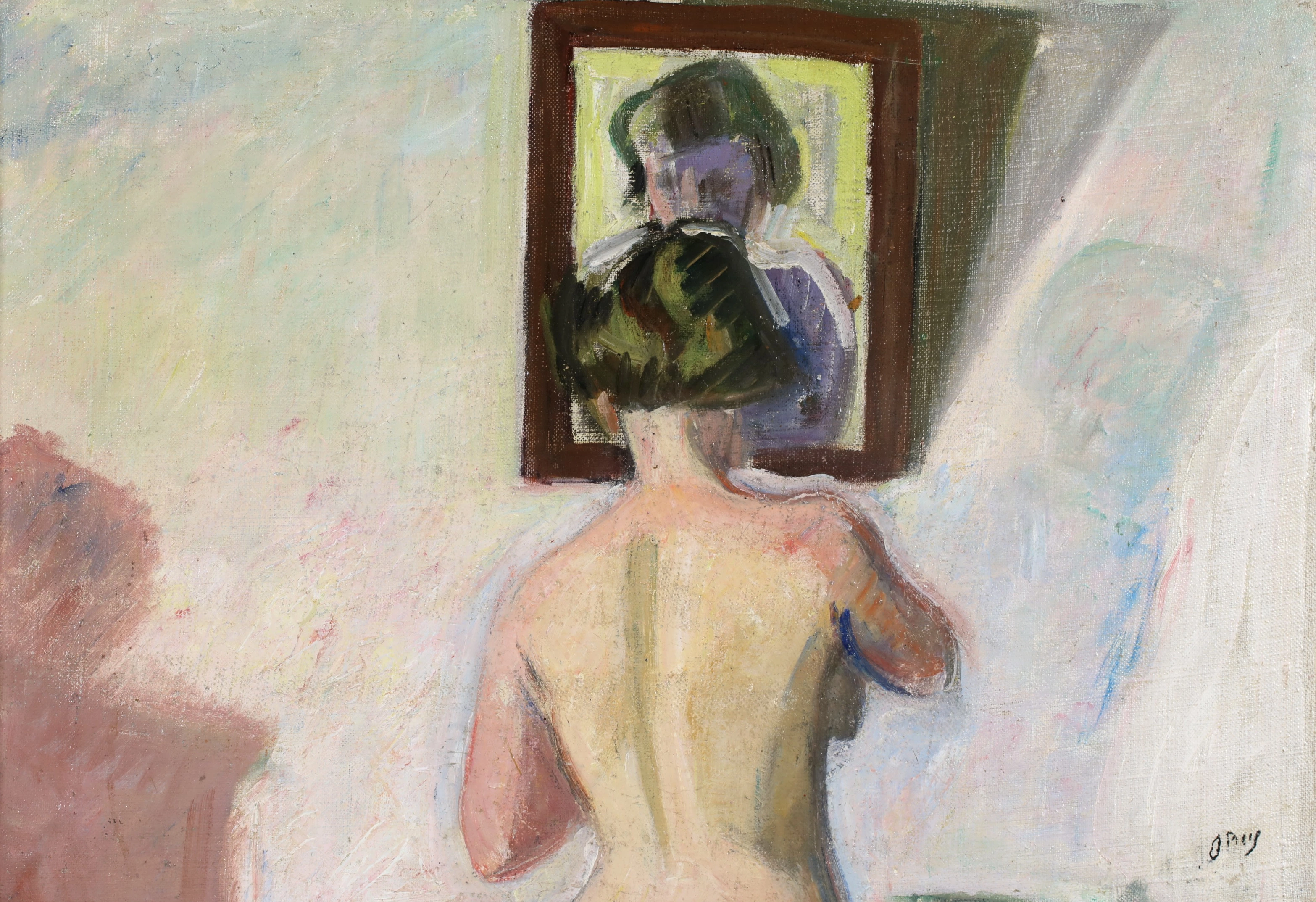
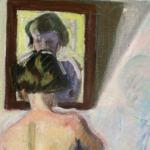
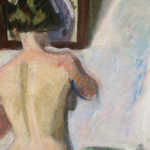
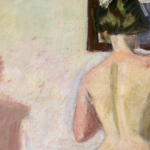
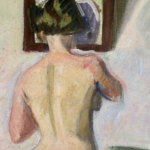
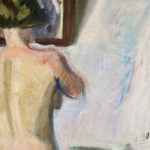
Toilette au miroir
Further Images
Toilette au miroir thumbnail
MediumOil on canvas
SignedSigned with cachet lower right
Size15.00" × 18.00" (38.1cm × 45.7cm)
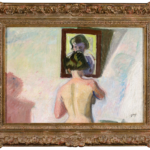
Framed Size22.00" × 25.00" (55.9cm × 63.5cm)
Dated1910
ConditionVery good condition
ProvenanceThe artist's studio (atelier stamp lower right).
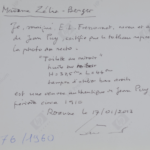
Accompanied by a certificate of authenticity from Louis Fressonnet-Puy — the artist's great-nephew and co-author of the catalogue raisonné — Roanne, 17 January 2013, there dated circa 1910.
£23,950.00
GBP
Purchase This Work
Image download 1Image download 2Image download 3Image download 4Image download 5Image download 6Image download 7Image download 8Image download 9Download all Images

Be the First to Know

Love the work of Jean Puy?

Sign up to receive notifications when new artworks by Jean Puy are added to our collection.

    Jean Puy Biography

    View full artist profile

    Jean Puy came from a family of industrialists. He obtained his baccalauréat in Litterature and Philosophy and began his foundation studies in architectural design at the École des Beaux-Arts in Lyons in 1895 and 1896. However, the teaching of the academic portraitist, Tony Tollet, inspired him to paint and, in 1898, he decided to go to Paris to study at the Academie Julian with Jean-Paul Laurens and Benjamin Constant. Later he turned to Eugène Carrière, in whose studio he became acquainted with other painters, including Henri Matisse, André Derain, Charles Camoin and Henri Manguin. Puy was mobilised in 1915 and transferred to a camouflage unit where he again met Camoin, as well as Villon and Dunoyer de Segonzac. He spent the interwar years in Paris, but in 1939 to 1940, fearing the bombing of the capital, he moved back to Roanne. In 1939, he decorated the hall of honour at the Lycée du Parc in Lyons with a fresco The Meeting of Ulysses and Nausicaa.

    Educated in the wake of Impressionism, Puy was an adherent of the Nabis and was acquainted with the Neo-Impressionist technique of Paul Signac. During his early Parisian period, he followed what was considered to be modern technique, sharing the same preoccupations as Camoin, Derain, Matisse, Vlaminck and others who met regularly in the studio of Manguin. This meeting of minds translated into their subject matter ( Self-portrait in Military Uniform, 1901, by Camoin was made as a response to Puy's Soldier), while, with his Nude in the Studio, 1900, Puy began to develop new techniques based on colour and form. On the subject of Matisse, with whom he shared the same model, Eugénie Frémissart, Puy wrote: 'I owe a great deal to his advice, his encouragement and his friendship.'

    A devotee of the Fauve movement in which he was supported by Apollinaire, Puy was represented by several canvases at the Salon d'Automne of 1905, in the room which first provoked Louis Vauxcelles to denounce the more modern paintings as 'fauves', leading to the coining of the term Fauvism. Among the significant works of this period were Resting beneath the Pine Trees, 1905, The Pink Pathway, around 1905-1910, and Bunch of Flowers, 1906. Whereas his brother Michel Puy was one of the first defenders of Fauvism, both in his articles and in his book The Latest Development in Painting (1911), Jean Puy was Fauve less by intellect than by an instinct for bright colours.

    The stir caused by the Fauve room at the Salon d'Automne of 1905 led to Puy being presented to the art dealer, Ambroise Vollard, on the recommendation of Matisse. Vollard purchased a considerable proportion of his work and, in 1919, commissioned him to engrave a set of illustrations to Father Ubu at War, followed by, Mother Ubu's Vase of Flowers in 1924, and The Archbishop's Lunch. It was also Vollard who commissioned him to decorate a hundred or so ceramic pieces (plates, vases, dishes, tiles) executed by André Metthey between 1905 and 1910.

    World War I brought a break in Puy's work. Removed from the visual innovations of Cubism, and the influence of the Nabis and Fauves, he remained faithful to principles of formal balance and chromatic harmony, dedicating himself to the visual recollection of a place or an ambiance and continuing to paint his favourite subjects, such as the landscapes of Britanny ( The Church of Sauzon, Belle Ile, around 1933-1934), the south of France or Forez in the Massif Central, seascapes ( The Port of Saint Tropez, 1920), still lifes ( The Pink Shelf, 1925), intimist and domestic scenes ( The Schoolgirl, around 1935, Reading by Lamplight, 1938) and many sensual female nudes ( Nude in front of the Window, 1930), often portrayed inside studios ( Nude on the Divan in the Studio, 1930). Puy's seascapes can be compared with those of Marquet and Camoin, and his intimist scenes, around 1935, with those of Vuillard, without forgetting the recurrent influence of Matisse in terms of subject matter ( Odalisque, around 1923), compositions with arabesques ( Le Grand Nu sauvage, 1920) and a preference for richly coloured fabrics ( Woman in an Armchair, 1930).

    After returning to his native region in 1939-1940, Puy became an important figure in the cultural life of the area. By the 1950s he was forgotten in Parisian circles and seldom exhibited in the capital. Artistically, like Espagnat, Manguin, Albert André, Valtat, Camoin and others, Puy remained faithful to the more traditional forms of representation associated with the School of Paris.

    His work was represented at the Salon des Indépendants from 1901 until 1908, and he became a regular exhibitor at the Salon d'Automne from its foundation in 1903. He also regularly took part in group exhibitions in Paris at Druet's between 1912 and 1938, as well as at the Bernheim Jeune Gallery from 1907 to 1927. Nine of his works were exhibited at Masters of Independent Art ( Maitres de l'Art Indépendant) at the Petit Palace in Paris as part of the Exposition Internationale of 1937.

    Solo exhibitions included: 1907, Eugène Blot Gallery, Paris; 1907, Druet Gallery, Paris; 1907, an exhibition organised by Vollard at the Dru Gallery, Paris; 1930, Bernheim Jeune Gallery, Paris; 1945, Boétie Gallery, Paris; 1946, Champion-Cordier Gallery, Paris; 1949, Laurenceau Gallery, Paris; 1950, 62 paintings at the Town Hall in Roanne; 1957, Vendôme Gallery, Paris; 1959, retrospective, Salon d'Automne; 1963, Musée des Beaux-Arts, Lyons; 1965, Durand Ruel Gallery, Paris; 1970, Women as seen by Jean Puy, La Cave Gallery, Paris; 1976, 1989, Musée Joseph Déchelette, Roanne; 1977, Paintings and Pastels of Jean Puy ( Peintures et Pastels de Jean Puy), La Cave Gallery, Paris; 1995, Musée Jacobins, Morlaix.

    Museum and Gallery Holdings

    Bagnols-sur-Cèze (Mus. Albert-André): Cherries (1925); The Roofs of Villeneuve-les-Avignon (c. 1929)
    Besançon (MBA et d'Archéologie): Ginette, the Model (c. 1930)
    Bourg-en-Bresse (Mus. de Brou): Self-portrait (c. 1920)
    Geneva (Petit Palais): The Painter and his Model with an Parasol, in Belle-Ile (1905); The Beach at Sunset (1907); Yachts in the Port of St Tropez (1930)
    Grenoble (Mus. de Grenoble): Woman Wearing a Mauve Shirt (1905)
    Le Cateau-Cambrésis (Mus. Matisse): Summer Afternoon (1929)
    Lyons (MBA): Nude in front of the Window (1930); View of the Port of Concarneau (c. 1933-1935)
    Montbéliard (Mus. du Château des Ducs de Würtemberg): The Pink Shelf (1925)
    Mulhouse: The Port of Doèlon (1933)
    Paris (MAMVP): The Schoolgirl or Study (1933-1934); Snow-Covered Landscape in Abriès (c. 1936)
    Paris (MNAM-CCI): Landscape of St-Alban-les-Étaux (c. 1902-1903); The Abbey of Longpont (1910); The Bed (c. 1923); Reading; Summer Afternoon; Young Girl in Blue
    Paris (Mus. du Petit Palais)
    Rheims (MBA): Portrait of a Soldier (1903)
    Roanne (Mus. Joseph-Déchelette): Nude in the Studio (1900); The Monk or the Reader (1907); Self-portrait (1908); Boarding school on the Beach (c. 1919-1920); The Arrival of the Steamer at the Palais Port in belle Ile (c. 1920-1925); Reading (c. 1923)
    Rouen (MBA): Noble Landscape (1904)
    St-Étienne (Mus. d'Art et d'Industrie)
    St-Tropez (Mus. de l'Annonciade)
    Troyes (MAM): Nude in the Studio

    Response in
    3 Hours

    Our specialist team aims to respond to all inquiries within 3 hours during our opening hours.

    Google Logo REVIEWS.io Logo

    Client Satisfaction
    Guarantee

    Boasting over 200 five-star reviews across Google, 1stDibs, and REVIEWS.io.

    1stDibs Logo

    Platinum
    Seller

    Recognized as an experienced seller who consistently exceeds customer expectations.

    Member since 2016 with over 100 five-star reviews.

    Two Decades
    of Expertise

    Leighton Fine Art brings over two decades of experience in the fine art industry.

    © 2026 Leighton Fine Art Ltd. All rights reserved.

    Registered in England & Wales · 08072141  ·  Terms & Conditions