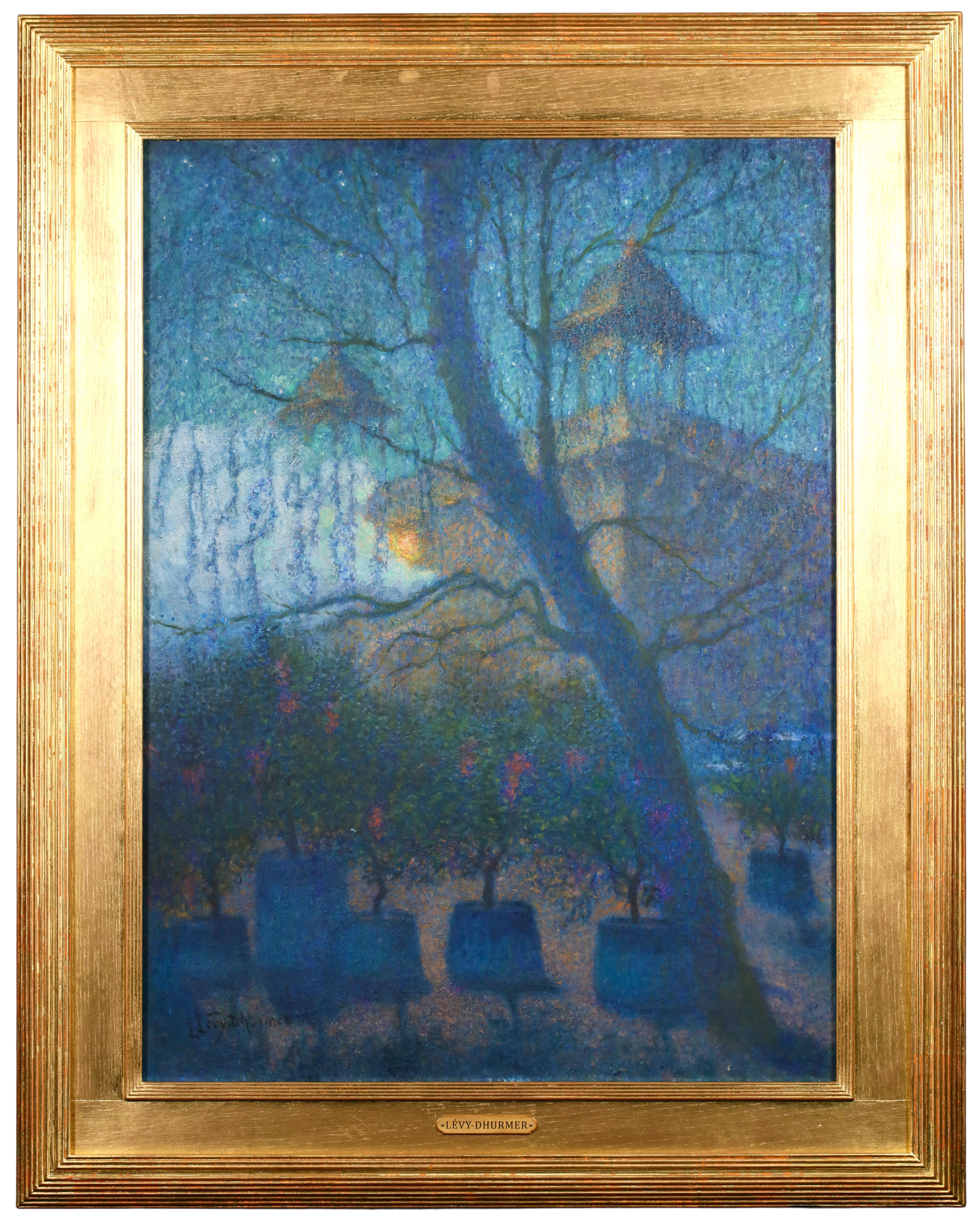
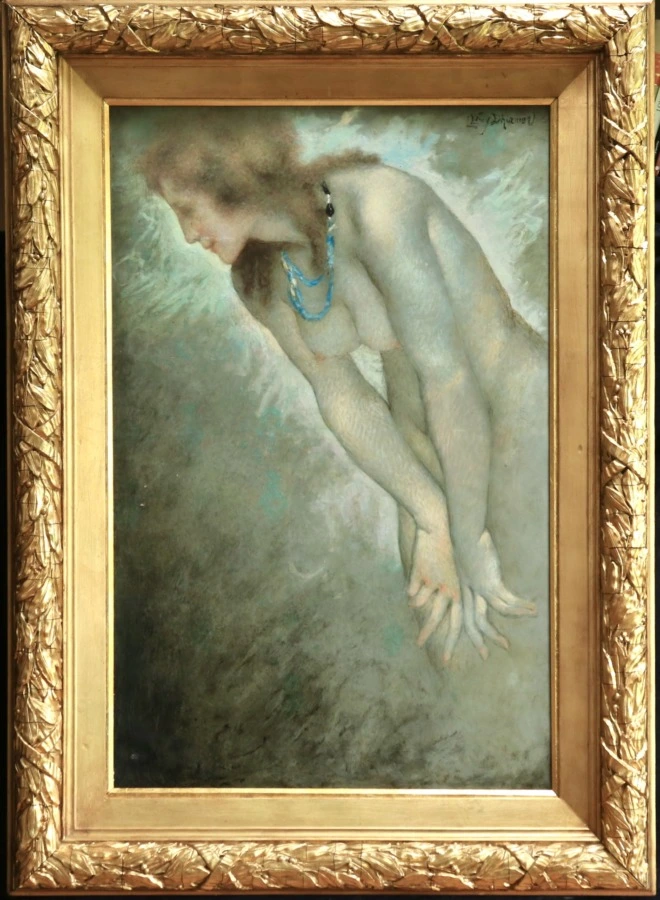
Lucien Lévy-Dhurmer did not follow the conventional route for education in fine arts but was nevertheless a pupil of the painters Raphaël Collin, Vio and Wallet. He was an ornamental painter in an earthenware factory in Golfe-Juan from 1887 to 1895, which influenced his use of pastel. He travelled to Italy in 1895.
Around 1902 he painted the portraits of Rodenbach, Pierre Loti and Marguerite Moreno. Although he had not been instructed by Puvis de Chavannes or Gustave Moreau, he seemed to have much in common with those visionary 'painters of the soul' who had been exhibiting at the Salon de la Rose-Croix for several years: Edmond Aman-Jean, Louis Welden Hawkins, Henri Martin, Charles Maurin and Alphonse Osbert. Following the example of some of these artists, Lévy-Dhurmer admired Italian Renaissance art, evidence of which can be seen in pastels such as Woman with a Medal, Medusa, Circes and Florence. His translation of the Symbolist themes in the scores of Beethoven ( Appassionata), Fauré or Debussy into different hues made him seem like a visionary, but his aesthetic seems to have changed to some extent after 1900, when his landscape painting became more prominent. In fact, only his presentation and style changed. He continued to suggest feelings, interpretations and emotions but without relying on any traditional allegories. He became involved in the Intimist movement, along with Ernest Laurent, Charles Cottet, Henri le Sidaner and René Ménard, whose pastels presaged the Classicism of the 1930s.
He exhibited at the Salon des Artistes Français in Paris from 1882. From 1906 he was associated with the Salon de la Société Nationale des Beaux-Arts. He showed his works in individual exhibitions, notably in 1896 at the Galerie Georges Petit in Paris, which was a very successful exhibition and earned him admiration in artistic and literary circles alike. Several decades later the exhibition Around Lévy-Dhurmer ( Autour de Lévy-Dhurmer) at the Galeries du Grand Palais in Paris in 1973 revealed a tendency in art which had been largely unknown until then and which remained on the margins of the great innovative movements of the 20th century, but which was nonetheless of a quality which could not be ignored. Lévy-Dhurmer obtained a distinction from the Salon des Artistes Français in 1896 and a bronze medal at the 1900 Exposition Universelle in Paris. He became a Chevalier of the Légion d'Honneur in 1902.
Museum and Gallery Holdings
Bayonne (Mus. Basque): Portrait of Pierre Loti (1896, pastel)
Brest (MBA): Circes
Detroit (AI): Vase with Dragonflies (1890, earthenware with iridescent glaze)
Mulhouse: Harvest
New York (Metropolitan Mus. of Art): Flower Pot (c. 1893, earthenware with metallic glaze)
Paris (Mus. d'Orsay): Portrait of Georges Rodenbach (c. 1895, pastel on paper); The Woman with a Medal (1896, pastel on paper on card); The Lost Explorer (1896, pastel on paper); Medusa (1897, pastel and charcoal on paper on card); The Witch (1897, pastel on paper); Florence (c. 1898, pastel); The Blind of Tangiers (1901, pastel on paper); Portrait of Mademoiselle Carlier (c. 1910, pastel on paper); Portrait of Georges Dumas (1927, pastel on paper)
Paris (Mus. de l'Armée): Terror
Paris (Mus. du Petit Palais): The Appassionata
Quimper (MBA): Notre-Dame de Penmarc'h (1896, oil on canvas)