Further Images
| Medium | Oil on panel |
| Signed | Signed lower left / titled verso |
| Size | 10.00" × 14.00" (25.4cm × 35.6cm) |
| Framed Size | 16.00" × 20.00" (40.6cm × 50.8cm) |
| Dated | c. 1900 |
| Condition | Very good original condition |
| Provenance | Sotheby's New York c. 1980 (labels verso) |
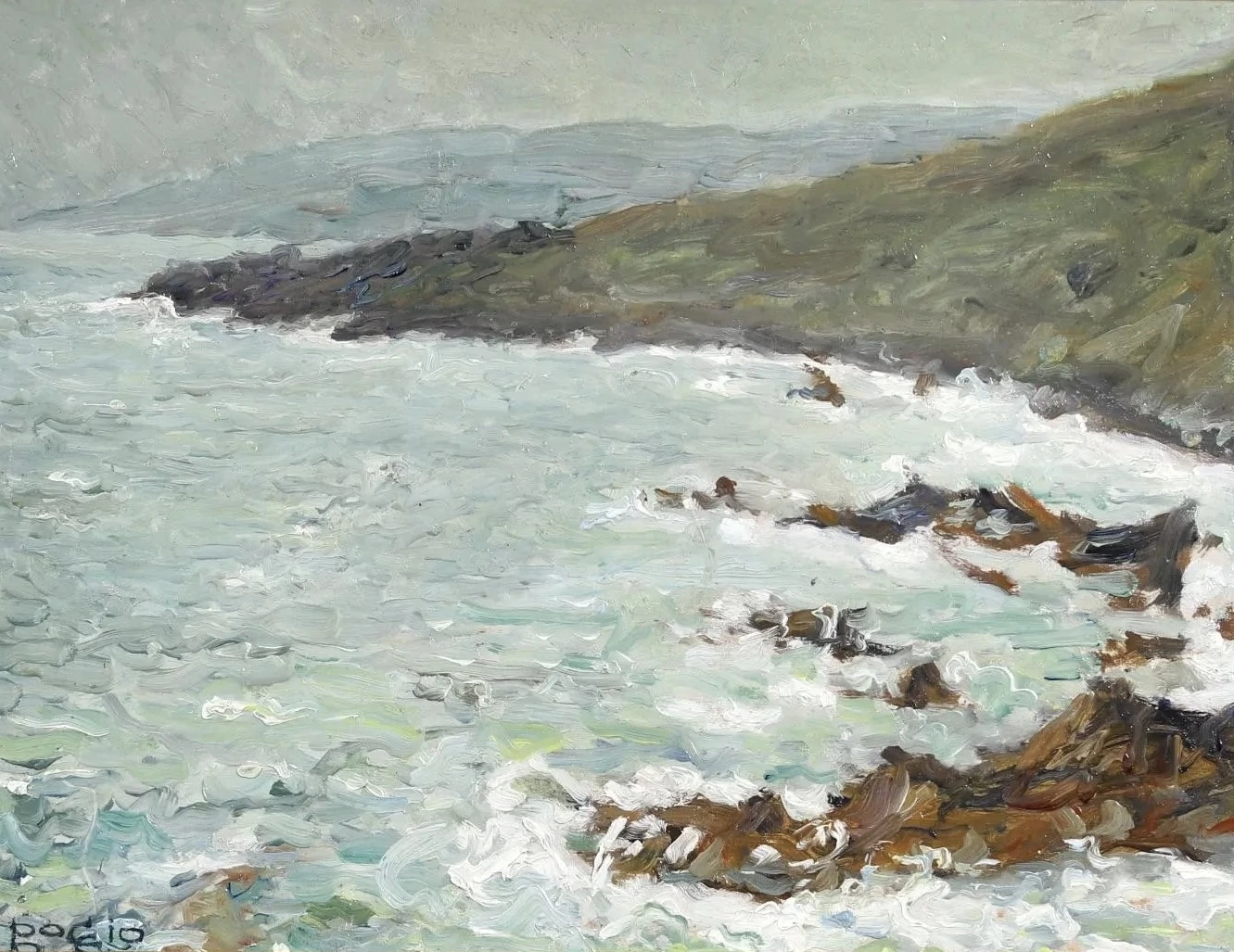
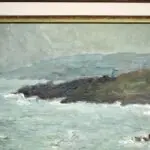
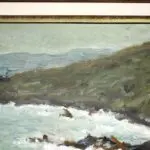
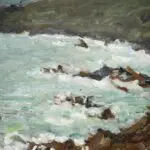
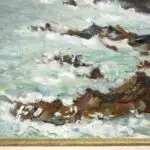
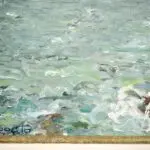
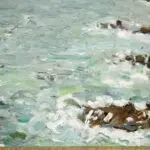
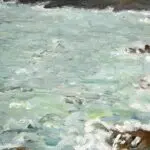
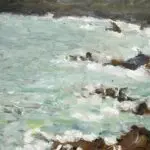
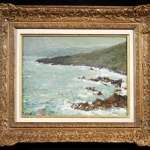
| About this Painting | Rocks in grey weather — the title is spare and exact, and so is the painting. A rocky coast under an overcast sky, the sea working against the stone in broken white foam, the water between the rocks a cool, clear turquoise that deepens to grey where the sea runs undisturbed. Emilio Boggio (1857–1920) understood this kind of light intimately: the particular quality of an overcast Atlantic or Mediterranean day, the way grey weather strips colour down to its essentials and forces the painter to look harder than sunshine ever does. The panel is small — ten by fourteen inches — and all the better for it. Small panels made quickly outdoors, looking directly at the motif, are where Boggio's Impressionist practice shows most clearly. The brushwork is rapid and physically engaged: curved strokes follow the movement of the water, shorter, more irregular marks build the texture of the rock surfaces, the foam is applied in heavy white impasto that has genuine material presence. The cool greens and blues of the water are the most accomplished passages — observed at exactly the right moment and set down without hesitation. Born in Caracas in 1857 to an Italian father and Venezuelan mother of French and Spanish descent, Boggio spent his life oscillating between Venezuela and France — sent to Paris to study commerce, returning to the family business, escaping back to Paris to paint. He finally committed to painting for good at the Académie Julian, studying under Jean-Paul Laurens and meeting Henri Martin, who became a lifelong friend and fellow traveller in the Impressionist tradition. He befriended Camille Pissarro and became one of the most accomplished Impressionist painters working in France across the turn of the century, exhibiting at the Salon des Artistes Français and the Salon d'Automne. Between 1907 and 1909 he lived in Italy and made a sustained series of seascapes — of which this panel is a characteristic example. He died at Auvers-sur-Oise in 1920, the same village where Van Gogh spent his final weeks. His work is held in the Musée du Luxembourg in Paris, the Philadelphia Museum of Art, and the Museo de Bellas Artes in Caracas, where he is celebrated as the father of Venezuelan Impressionism. |
£5,350.00
GBP