
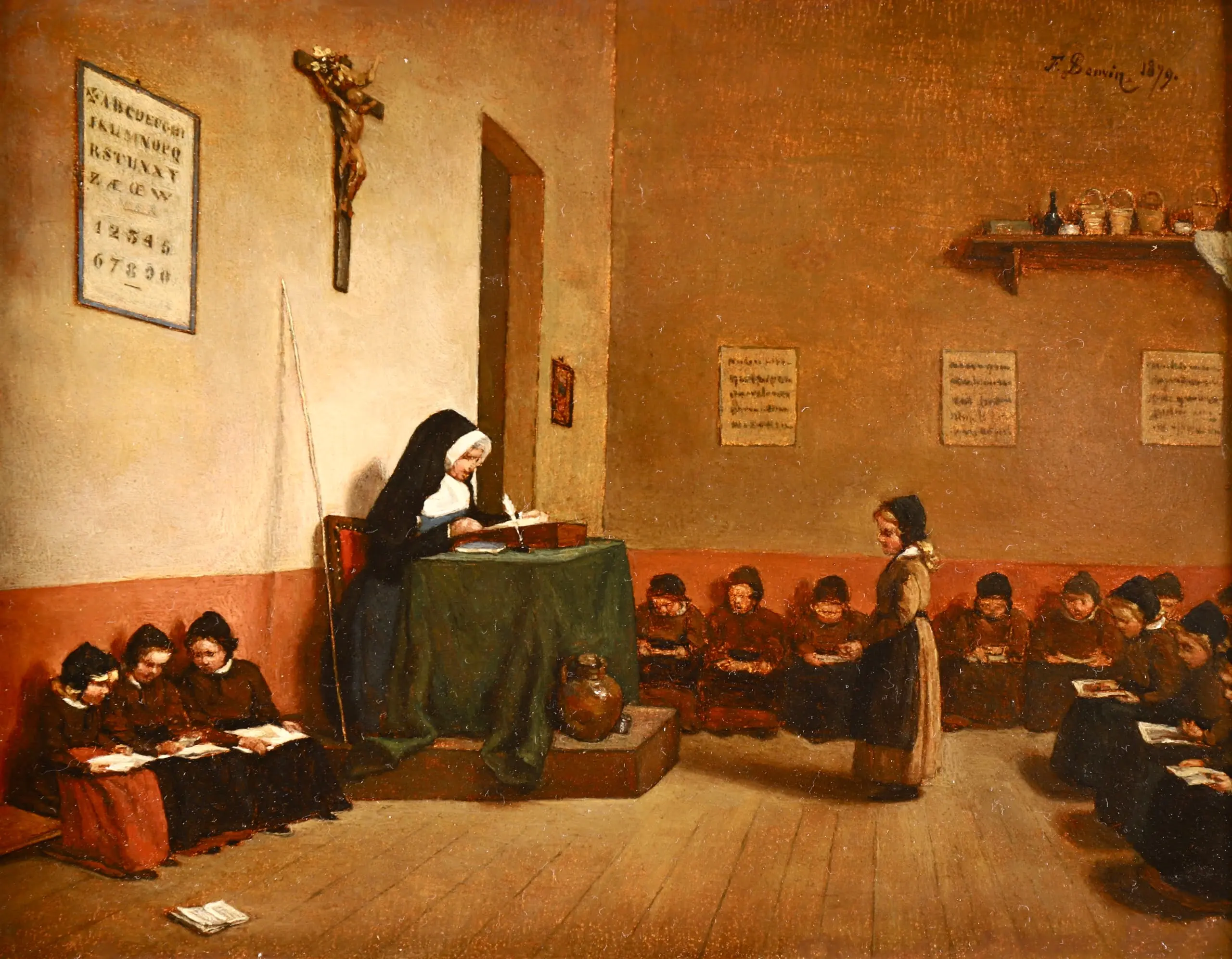
Francois Bonvin

( 1817 - 1887 )

Les jeunes écoliers

Francois Bonvin

( 1817 - 1887 )

Les jeunes écoliers

  • Medium: Oil on panel

  • Signed: Signed & dated 1879 upper right

  • Size: 0.00" x 0.00" (0.0cm x 0.0cm)

  • Dated: 1879

SOLD

Additional information

  • Condition: Very good original condition

  • Provenance: Maitre Francis Briest - Paris (19th February 1994)

Be the First to Know

Love the work of Francois Bonvin?

Sign up to receive notifications when new artworks by Francois Bonvin are added to our collection.

    Francois Bonvin Biography

    View full artist profile

    François Bonvin's father was a game-keeper, first in Vaugirard and then in Montrouge. François Bonvin learnt to draw at a free course given in the Rue de l'École de Médecine, and after two years, forced to make his living, he became a type-setter, and then took a job in the Prefecture of Police. In his spare time he toured the museums, especially the Louvre, where he studied the Flemish and Dutch masters. He amassed sketches and watercolours of landscapes from life and portraits of the people he mixed with. In the evening he worked first at the Gobelins studio, and later at l'Académie Suisse. He first exhibited in 1847 with Portrait of the Historian Augustin Challamel, but the following year he began to specialise in genre painting in which he soon showed himself to be very skilful. His submissions of 1849 were the proof: Cook, Drinkers, and Piano won him a third-class medal. He decided to resign from the Prefecture in order to devote himself to an official commission, School for Orphan Girls, which received a second-class medal at the Salon of 1851 and some critical acclaim. His later submissions all contain interesting work: Charity (1859), Low Mass (1855), Letter of Recommendation (1859), Bar, an everyday scene perhaps copied from the establishment his father then ran in Vaugirard, Copper Fountain (1861), Apprentice Having his Lunch (1863), Pew for the Poor (1865), Grandma's Café (1866), Friars' School and Woman Washing Dishes, Pig (1875). A friend of Courbet, he exhibited at the first Salon des Refusés. He also engraved a number of etchings. His visits to Flanders and Holland were especially happy times for him. In 1870 he was awarded la Légion d'Honneur. His life ended very unhappily. Despite an operation in 1881, his health deteriorated seriously and he lost his sight completely. He would have been reduced to penury had his friends and colleagues not organised a retrospective exhibition in May 1886 and an auction for his benefit in 1887.

    Bonvin can be considered as one of the best genre painters of the 19th century. There are two stages in the development of his talent. First of all he was a disciple of the Flemish painters he copied in the Louvre in his realist paintings such as Drinkers of 1849, in which he uses colour generously and freely. Without entirely giving up this style, to which he was to return with Bar and Pig, he developed softer forms and a more intimate feeling. As a painter of interiors he could be called the new Chardin. His still-lifes are restrained and masterly in a way that is reminiscent of Baugin. From Chardin he borrowed a simplicity of composition and a truthfulness in colour. One of the attractions of his canvases is the great variety of light effects, sometimes bright, sometimes discreet and blurred, depending on the subject.
    Group Exhibitions

    2002, 'Men of Worth': Henri Fantin-Latour, Odilon Redon and their Contemporaries ("Hommes de valeur". Henri Fantin-Latour, Odilon Redon en tijdgenoten (and their contemporaries)), Kröller-Müller Museum, Otterlo

    Museum and Gallery Holdings

    Amsterdam (Rijksmus.): Still-life (1871, oil on canvas)
    Arras: Bar
    Bayonne: Nonore
    Besançon: Letter of Recommendation
    Cardiff (Nat. Mus. of Wales): A Woman Ironing (The Laundress) (oil on canvas); The Young Housewife (oil on panel)
    Chambéry (MBA): Young Girl Sitting (oil on canvas)
    Dijon (MBA): The Foundry (1852, watercolour, pen and Indian ink on paper); Sounding the Hunt (1880, oil on canvas)
    Langres: School for Orphan Girls
    Limoges: Reeling Machine
    London (NG): The Meadow (1869, oil on canvas); Still Life with Book, Papers and Inkwell (1876, oil/zinc, on loan since 1979 at the Hugh Lane Municipal Gallery of Modern Art, Dublin)
    London (Victoria and Albert Mus.): Breton Spinner; On the Banks of the Rance; Coming out of the Cellar
    Melun: Coming out of the Pantry
    Montargis: Musical Instruments
    Montpellier: Pew for the Poor; Woman Reading
    Mulhouse: Cook
    Niort: Charity
    Philadelphia (MA): Woman Ironing (1858, oil on canvas); The Engraver (1872, oil on panel)
    Paris (Mus. d'Orsay): Copper Fountain, Kitchen Interior (1861, oil on canvas); Ave Maria (1870, oil on canvas); Refectory (1872, oil on canvas); Port-Marly (1872, oil on panel); Fallen Roofer (studies); Cloister
    Paris (Louvre): School for Orphan Girls (sketch); Abandoned Boat
    Rheims: Woman Washing Dishes; Pig; Bowl of Coffee
    Rouen: Two Jugs
    St-Germain-en-Laye: Entrance of Westminster Abbey
    St-Lô: Low Mass
    Toulouse (Mus. des Augustins): Smiths, memories of Tréport; Nun

    Response in
    3 Hours

    Our specialist team aims to respond to all inquiries within 3 hours during our opening hours.

    Google Logo REVIEWS.io Logo

    Client Satisfaction
    Guarantee

    Boasting over 200 five-star reviews across Google, 1stDibs, and REVIEWS.io.

    1stDibs Logo

    Platinum
    Seller

    Recognized as an experienced seller who consistently exceeds customer expectations.

    Member since 2016 with over 100 five-star reviews.

    Two Decades
    of Expertise

    Leighton Fine Art brings over two decades of experience in the fine art industry.

    Share on social media

    A2A - Logo Facebook - Logo Facebook Messenger - Logo X - Logo LinkedIn - Logo Email - Logo WhatsApp - Logo