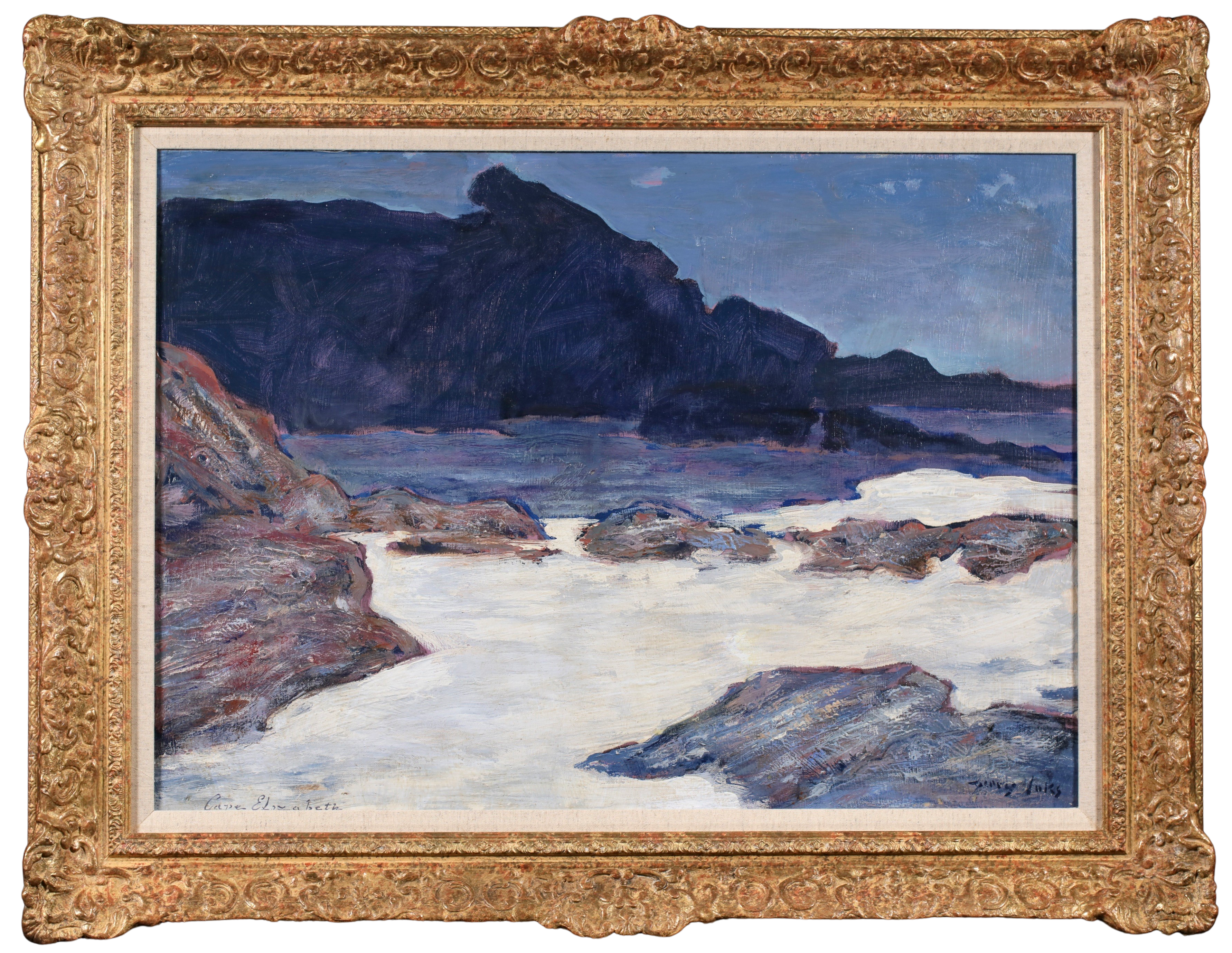
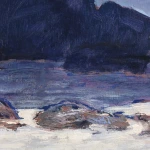
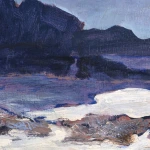
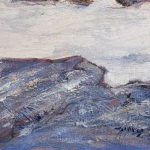
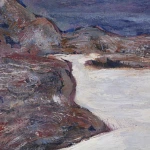
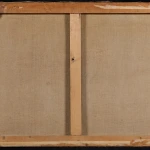
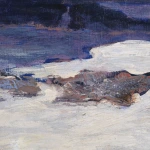
Medium: Oil on canvas
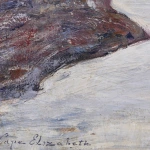
Signed: Signed lower right and titled lower left
Size: 20.00" x 28.00" (50.8cm x 71.1cm)
Framed Size: 26.00" x 34.00" (66.0cm x 86.4cm)
Dated: c. 1922
£26,500.00
GBP
Additional information
Condition: Very good condition
Provenance: Private collection - United Kingdom
Literature: This work is one of a series of paintings of this scene painted by the artist between 1919 and 1922. Luks had travelled to Nova Scotia in 1919 from Maine and had noted the landscape and painted it before returning in the summer of 1922 when he rented a small farmhouse on Pond Cove where from he painted the area extensively.
Love the work of George Benjamin Luks?
Sign up to receive notifications when new artworks by George Benjamin Luks are added to our collection.
George Luks received his artistic training as a student at the Pennsylvania Academy of Fine Arts in Philadelphia, and then completed it in Düsseldorf, Paris and London. On returning to Philadelphia in 1895, at the beginning of his career, he earned his living by illustrating newspaper articles, an activity which was soon replaced by press photography. In 1896, sent as a reporter to Cuba by the Evening Bulletin, to follow the Spanish military operations against the native nationalist insurrection, he was taken prisoner by the insurgents and condemned to death. Having succeeded in escaping, he made his way back to the USA and, after setting up in New York, then worked for the New York Herald Tribune. Devoting himself almost entirely to painting, his social convictions and interest in the living conditions of contemporary working people attracted him to the realist principles of Thomas Eakins, echoed in the 20th century by Robert Henri in his theoretical work The Art Spirit. In 1907, a collection of paintings by Luks, John Sloan and William Glackens having been refused by the National Academy of Design, Robert Henri, who was a member of the Academy, withdrew his own in protest. In 1908, the same artists, joined by Everett Shinn, Maurice Brazil Prendergast, Ernest Lawson and Arthur B. Davies, formed a group, resolutely against the Post-Romanticism of the Academy, and exhibited at the Macbeth Gallery in New York, before becoming The Eight. The desire, common to all the painters in the group, to give, in varying degrees, realist images of modern life, evoking the sounds, smells and squalor of urban and working existence, brought them the title of the Ashcan School, in which they were joined by other young painters, including George Bellows. This group of artists, motivated by their opposition to the National Academy of Design and the prevailing conservatism, was the origin of the historic so-called Armory Show in 1913, where the works by the invited European artists, until then totally unknown, would bring about the international beginning of American art. In 1918, Luks received a gold medal from the Academy of Fine Art in Philadelphia.
Entirely in keeping with the realist principles of the Ashcan School, Luks most often gave a social content to his works. A characteristic example of this is The Miner, now in the National Gallery of Art in Washington, whose harassed face reflects the hardness of his toil and the misery of his condition. In this period of generous enthusiasm, Luks's method of working was inspired by the trueness of touch of Frans Hals, and remained connected to the muted range practised by the artists of the group following Robert Henri. As often with the other artists of the group, he favoured nocturnal scenes and interiors in artificial light, suitable for theatrical lighting effects. He knew in particular how to make the colour details of the faces, hands and significant details emerge from the night or the shadows, as if he were a Frans Hals of The Bronx. In 1918 he painted the vast crowd scene called The Night of the Armistice in 1918, now in the Whitney Museum in New York, in which he was able to deploy all the resources of his passion and an epic sense of composition, his usual muted range here lit up and given colour by the deployment of the Allied flags in the lights of the jubilant street. After World War I, his works showed some signs of decline. Nonetheless, George Luks played a decisive part in the liberation of American painting from the sterile conventions of the Academy.
Group Exhibitions
1965, Robert Henri and his Circle, American Academy of Arts and Letters, New York
2003, Edward Hopper and Urban Realism, Columbia Museum of Art, Columbia
Solo Exhibitions
1973, George Luks, 1866-1933: An Exhibition of Paintings and Drawings dating from 1889-1931, Museum of Art, Munson-Williams-Proctor Institute, Utica, New York
1987, George Luks: an American Artist, Sordoni Art Gallery, Wilkes College, Pennsylvania
Museum and Gallery Holdings
Andover (Addison Gal. of American Art): The Spielers (1905, oil on canvas)
Ann Arbor (University of Michigan Mus. of Art): four drawings
Boston (MFA): The Wrestlers (1905, oil on canvas); Noontime, St. Botolph Street, Boston (c. 1923, oil on canvas); View of Beacon Street from Boston Common (c. 1923, oil on canvas); A Clown (1929, oil on canvas)
Chicago (Terra Foundation for American Art Collection): Knitting for the Soldiers: High Bridge Park (c. 1918, oil on canvas)
Detroit (IA): Three Top Sergeants (1925, oil on canvas)
Los Angeles (County MA): Czechoslovakian Army Entering Vladivostok, Siberia, in 1918 (1918, oil on canvas); Pedro (early 1920s, oil on canvas)
New Orléans (Isaac Delgado Fine Arts Gal., Delgado Community College)
New York (Metropolitan Mus. of Art)
New York (Whitney Mus. of American Art): The Night of the Armistice in 1918
Pittsburgh (Carnegie MA): Garden of the Tuileries, Paris (1902, watercolour); Homer Saint-Gaudens (1931, oil on canvas)
Washington DC (Hirshhorn Mus. and Sculpture Garden): Girl In Green (c. 1925-1929, oil on canvas); Sailboat at Night (Maine) (1922, oil on canvas)
Washington DC (NGA): The Bersaglieri (1918, oil on canvas); The Miner (1925, oil on canvas)
Washington DC (Phillips Collection): The Dominican (1912, oil on canvas); Blue Devils on Fifth Avenue (1918, oil on canvas); Otis Skinner as Col. Philippe Bridau (1919, oil on canvas)
Youngstown (Butler Institute of American Art): The Café Francis (c. 1906, oil on canvas)
Response in
3 Hours
Our specialist team aims to respond to all inquiries within 3 hours during our opening hours.


Client Satisfaction
Guarantee
Boasting over 200 five-star reviews across Google, 1stDibs, and REVIEWS.io.

Platinum
Seller
Recognized as an experienced seller who consistently exceeds customer expectations.
Member since 2016 with over 100 five-star reviews.
Two Decades
of Expertise
Leighton Fine Art brings over two decades of experience in the fine art industry.
Share on social media


