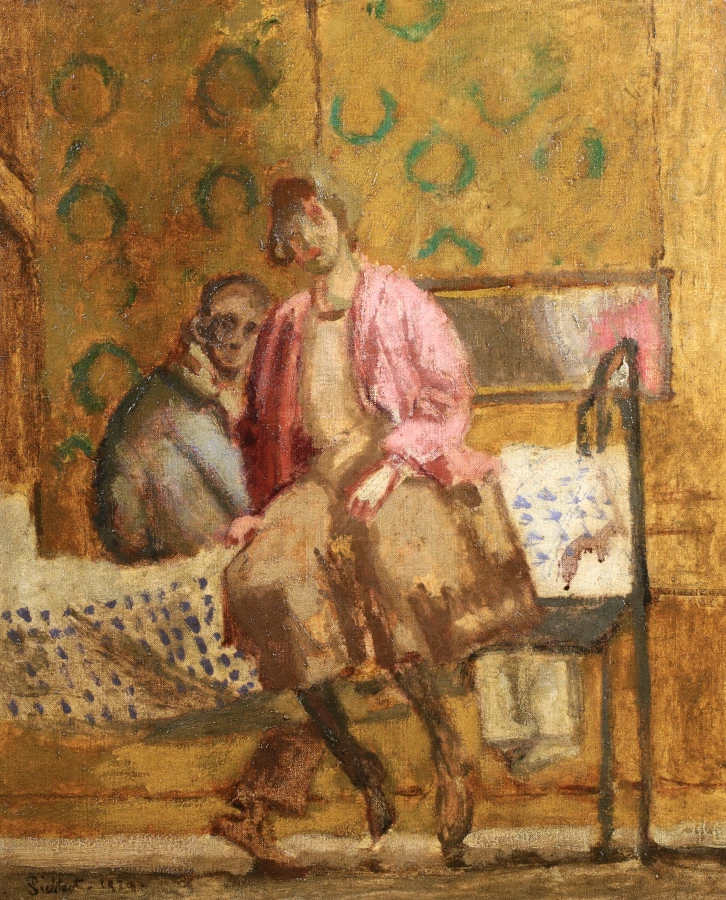
Love the work of Walter Sickert?
Sign up to receive notifications when new artworks by Walter Sickert are added to our collection.
Walter Sickert Paintings
Walter Richard Sickert was the brother of Bernhard, son of Oswald Adalbert and grandson of Johan Jurgen Sickert. His Danish-German father worked on a satirical journal in Munich ( Fliegende Blätter). In 1868, following the annexation by Germany of Schleswig-Holstein, the Sickerts moved to England, where the entire family secured British nationality.
Walter Sickert embarked on a career as an actor but in 1881 secured a scholarship which enabled him to study at London’s Slade School, thereby following in the family tradition. One of the first to take an interest in Sickert and his work was James Abbott McNeil Whistler, who also encouraged Sickert to take up engraving. In 1883, Whistler entrusted Sickert with the task of conveying his now celebrated Portrait of the Artist’s Mother to the Paris Salon; he also commended Sickert to his friends Edouard Manet and Edgar Degas. Sickert was unable to meet with the former (who was nearing the end of his life), but he did meet Degas, who befriended him and used him from time to time as a model.
In 1885, despite the opposition of her family, Sickert married Ellen Cobden, daughter of the prominent politician Richard Cobden. The newly-weds set off on their travels, visiting Munich, Vienna, Milan and making a first visit to Dieppe, the French harbour town to which Sickert would return time and again and which was to play such a key role in his career as an artist. Degas, meanwhile, secured Sickert introductions to Elie and Jacques Halévy, Jacques-Emile Blanche, Henri Gervex and others. It would appear that, in 1893, Sickert opened and taught in an académie libre; what is certain, however, is that he taught at Westminster Art School until 1918.
In 1895, possibly at Whistler’s instigation, Sickert visited Venice. 1899 proved to be a difficult year: Sickert had divorced Ellen and was determined to put England behind him for as long as possible. He joined up with Jacques-Emile Blanche in Dieppe and spent the turn of the century in Paris. He eventually returned to England in 1905 and set himself up in a studio in Bloomsbury, where old friends and new – Lucien Pissarro, George Moore and Augustus John among them – were frequent visitors.
Sickert remarried in 1911 and promptly returned to Dieppe. During the years of World War I, he spent time in Bath (1916 and 1917) but, as soon as the war was over, Sickert hastened back to his beloved Dieppe. In October 1920, tragedy struck when his second wife, Christine, died. Sickert returned to London in 1922. He was elected to membership of the Royal Academy in 1924 and taught there from 1926, devoting himself to the propagation of his approach to painting and contributing significantly to the rejection of sterile academism in English painting. He married for the third time in 1926.
By 1927, Sickert was reputed to have found recognition in some quarters as one of the leading artists in England and was on the point of being elected to the presidency of the Royal Academy; other accounts, arguably more reliable, suggest otherwise, namely that he was elected president of the British Artists Society in 1928 and admitted to Royal Academy membership only in 1934. In any event, he resigned from the Royal Academy the following year and effectively withdrew from London society, exiling himself in Bath, Broadstairs and Brighton.
As early as 1886 or 1888, Sickert had made known his intention to help rid English art of its academic strictures. Accordingly, he had involved himself in the launch of the New England Art Club and exhibited within the framework of that institution. In 1908, he was also involved in the establishment of the Allied Artists Association, a group set up along similar lines to the Salon des Indépendants in Paris. (The first London exhibitions of the work of the French Impressionists were held in 1910.) Then, in 1910-1911, Sickert set up a loose circle of artists known as the Camden Town Group, so called from the district of London Sickert was living in at the time. Little by little, the Camden Town Group revived the ideals postulated by the New England Art Club some twenty-odd years previously, to introduce into English painting some of the notions embraced by late 19th and early 20th-century French artists. Besides Sickert, the principal members of the group were Camille Pissarro’s son Lucien, Charles Ginner, Harold Gilman and Spencer Gore; these were the English equivalent of France’s Neo-Impressionists. The London Group was set up in 1914 as a successor to the Camden Town Group and most members of the latter gravitated towards the new group.
Sickert’s portraiture betrays the influence of Whistler in terms of its sombre colours, whereas his landscapes and seascapes of Dieppe, with their bathers and carefree young women, bear the stamp of Boudin, Manet and the French Impressionists. Sickert’s Loggias and Décors on the other hand, are very much in the mould of Degas, particularly the choice of theme and the off-centre compositional approach. Sickert’s range was impressive: Venetian views, Parisian street scenes ( Caf’ Conc’), seascapes, etc.
Up to 1910, Sickert’s female figures were, almost without exception, painted indoors as nudes perched on iron bedsteads or as part of a bored couple lounging on a sofa on a Sunday afternoon; in short, his treatment of women verged on misogyny. Around 1910, however, Sickert was commissioned to produce plates for the publication New Age, chiefly portraits of men and women; it may be that he was influenced by his remarriage, but his figures suddenly seem less lugubrious. By the time he started painting in Bath around 1916 and 1917, he was at the peak of his powers, painting splendid landscapes and seascapes rendered with an acute perception of changing light effects. Then, after the death of his second wife, he started painting circus and amusement parlour scenes in France, together with scenes of maisons closes. He also painted accomplished portraits, including Victor Lecour (1922) and Signor Battistini (1925). After 1926 and his third marriage, his landscape work became more serene again. Around 1930 and despite his growing infirmity, he set himself to painting stage sets.
Walter Sickert was an excellent painter but, bearing in mind the presence of Turner and Whistler and the overwhelming impact of Ruskin and the Pre-Raphaelites, his salient contribution to the history of English painting may well lie in the fact that he ‘brought painting out into the open air’. in any case Sickert dominated the English avant-garde between the years 1907 to 1914 until the advent of the Fauvists and Cubists, when his progressive approach was relegated to the ranks of Post-Impressionism.
Group Exhibitions
from 1915, Royal Academy, London
1998, James McNeil Whistler and Walter Richard Sickert, La Caixa Foundation, Madrid
2004, The Edwardians: Secrets and Desires, National Gallery of Australia, Canberra (travelling exhibition)
2005, Degas, Sickert and Toulouse-Lautrec: London and Paris 1870-1910, Tate Britain, London
2006, Sickert and his Circle, Cecil Higgins Gallery, Bedford
2008, Modern Painters: The Camden Town Group, Tate Britain, London
2008, From Sickert to Gertler: Modern British Art from Boxted House, Scottish National Gallery of Modern Art, Edinburgh
Solo Exhibitions
1907, 1909, Bernheim Jeune, Paris
1910, Stafford Street Gallery, London
1913, Carfax Gallery, London
1928, Saville Gallery, London (préface de Hugh Walpole)
1929, Leicester Galleries, London (major retrospective)
1941, National Gallery, London (comprehensive retrospective inaugurated by the Queen)
1979, Walter Sickert as Printmaker, Yale Center for British Art, New Haven
2000, Richard Sickert: Prints and Drawings, Fitzwilliam Museum, Cambridge
2004, Walter Sickert: ‘Drawing is the Thing’, Whitworth Art Gallery, Manchester
2007, Walter Sickert: The Camden Town Nudes, Courtauld Institute of Art, London
Museum and Gallery Holdings
Adelaide (AG of South Australia): Mornington Crescent Nude, contre-jour (1907, oil on canvas)
Boston (MFA): Les Petites Belges (Young Belgian Women) (oil on canvas); Carolina (1903-1904, oil on canvas); Les Vénitiennes (Venetian Women) (1903-1904, oil on canvas)
Brisbane (Queensland AG): Whistler’s studio (c. 1918, oil on canvas)
Bristol (City Mus. & AG): Horses of St Marks, Venice (oil on canvas); other paintings
Cambridge (Fitzwilliam Mus.): Mornington Cresent Nude (c. 1907, oil on canvas)
Cardiff (Nat. Mus. of Wales): Camden Town Portrait (oil on canvas); Palazzo Eleonara Duse, Venice (oil on canvas)
Chichester (Pallant House Gal.): Jack Ashore (c. 1912)
Dieppe: Royal Hotel, Dieppe; St Rémy Church, Dieppe
Eastbourne (Towner AG): The Poet and his Muse (1907, oil on canvas)
Edinburgh (Scottish Nat. Gal. of Modern Art): Corner of St Mark’s, Venice (c. 1901, oil on canvas); High-Steppers (c. 1938-1939, oil on canvas)
Glasgow (Hunterian AG): A Shop in Dieppe (c. 1886-1888, oil on canvas)
Leeds (City AG): Dieppe Harbour (oil/panel); The Laundry Shop (1885, oil/panel); Portrait of Ellen Heath (1896, oil on canvas); Self Portrait (c. 1896, oil on canvas); The Blackbird of Paradise (c. 1896-1898, oil on canvas, portrait); Off to the Pub (The Week End) (1912, oil on canvas); The Cafe Suisse (Cafe des Arcades, Dieppe) (1914, oil on canvas); The New Bedford (1916-1917, oil on canvas); Juliet and the Nurse (c. 1935-1936, oil on canvas); other paintings, two watercolours, drawings
Liverpool (Lady Lever AG): Bathers, Dieppe (1902, oil on canvas)
London (National Portrait Gal.): Charles Bradlaugh (1890, pencil); Philip Wilson Steer (c. 1890, oil on canvas, exhibited at the New English Art Club in 1890); George Jacob Holyoake (oil on canvas, exhibition 1892); Sir Winston Leonard Spencer Churchill (1927, oil on canvas); Walter Richard Sickert (1930, oil on canvas); William Maxwell Aitken, 1st Baron Beaverbrook (1935, oil on canvas)
London (Tate Collection): Café des Tribunaux, Dieppe (c. 1890, oil on canvas); George Moore (1890-1891, oil on canvas); St Mark’s, Venice (Pax Tibi Marce Evangelista Meus) (1895-1896, oil on canvas); Interior of St Mark’s, Venice (1896, oil on canvas); Dieppe, Study No. 2; Facade of St Jacques (c. 1899, drawing and watercolour/paper); Les Arcades de la Poissonnerie, Dieppe (c. 1900, oil on canvas); The Piazzetta and the Old Campanile, Venice (c. 1901, monotype print with ink wash/paper); Venice, la Salute (c. 1901-1903, oil on canvas); Sketch for `The Statue of Duquesne, Dieppe’ (c. 1902, carbon paper tracing and watercolour/paper); Woman Washing her Hair (1906, oil on canvas); Ennui (c. 1914, oil on canvas); A Marengo (c. 1903, oil on canvas); Aubrey Beardsley, 1894, oil on canvas (1894, oil on canvas); Miss Gwen Ffrangcon-Davies as Isabella of France (1932, oil on canvas)
Manchester (City AG): large collection of works, including Beach at Dieppe (1885, oil on panel); Mamma Mia Poveretta (c. 1904, oil on canvas); Jack the Ripper’s Bedroom (c. 1907, oil on canvas)
New Haven (Yale Center for British Art, Paul Mellon Fund): The Camden Town Murder or What Shall we do for the Rent? (c. 1908, oil on canvas)
New York (Metropolitan Mus. of Art): The Cigarette (Jeanne Daurmont) (1906, oil on canvas); Maple Street, London (c. 1915-1920, oil on canvas)
New York (MoMA): La Gaieté Montparnasse (c. 1905, oil on canvas); Sir Thomas Beecham Conducting (c. 1935)
Ottawa (NG. of Canada): Café des Tribunaux, Dieppe (1890, oil on canvas); The Old Bedford: Cupid in the Gallery (c. 1890, oil on canvas); Venetian Woman (Blackmail) (c. 1903-1904, pastel on paper mounted on board); Rue Notre-Dame, Dieppe (1902, oil on canvas)
Oxford (Ashmolean Mus.): St Mark’s, Venice: the West Front (oil/paper); The Lady in the Gondola (oil on canvas); The Bridge of Sighs, Venice (oil on canvas); Ennui (c. 1913, oil on canvas); La Gaieté, Montparnasse (oil on canvas); The Bust of Tom Sayers, a self-portrait (oil on canvas); other paintings; numerous drawings
Paris (MNAM-CCI): Boulevard Aguado, Dieppe
Rouen (MBA): Venetian Girl (c. 1901, major collection of watercolours and drawings)
Sydney (AG of New South Wales): The Oxford Music Hall (c. 1888-1889, oil on canvas); Portrait of the Artist’s First Wife, née Ellen Cobden (1892-1895, oil on panel); L’Homme à la Palette (Self-portrait) (c. 1893-1894, oil on canvas); The Flower Market, Dieppe (c. 1898, oil on canvas); Katie Lawrence at Gatti’s (c. 1903, oil on canvas mounted on board)
Walter Sickert Paintings
© 2026 Leighton Fine Art Ltd. All rights reserved.
Registered in England & Wales · 08072141 · Terms & Conditions