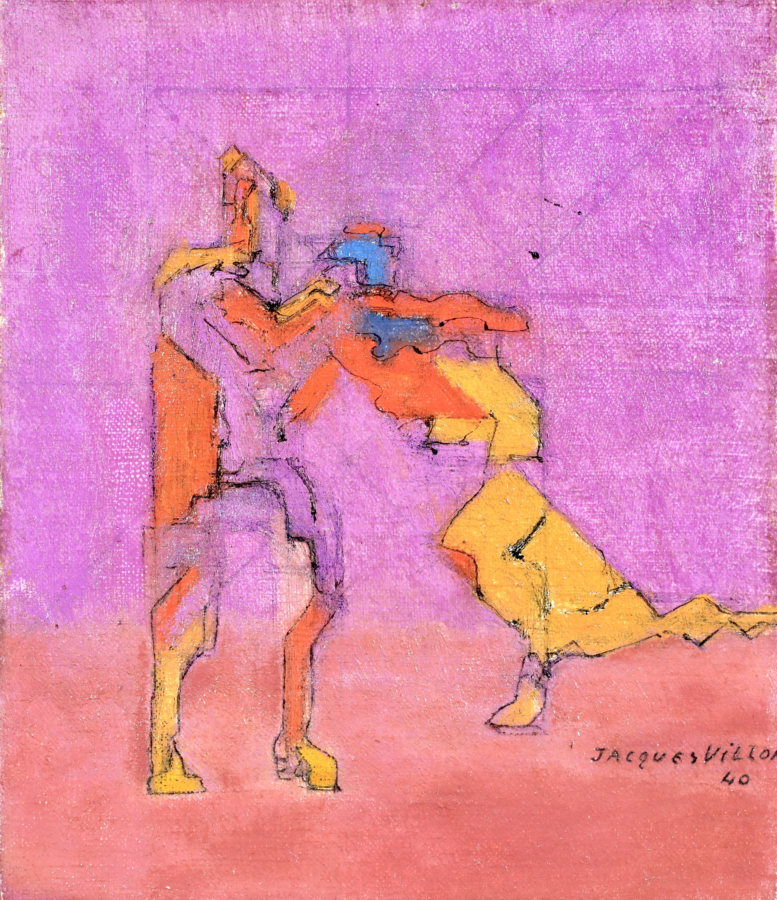
Love the work of Jacques Villon?
Sign up to receive notifications when new artworks by Jacques Villon are added to our collection.
Jacques Villon Paintings
Jacques Villon was born Émile Méry Frédéric Gaston Duchamp at Damville in Normandy on 31 July 1875, the eldest of four children who would all become artists. His brother Raymond Duchamp-Villon became a sculptor, his sister Suzanne a painter, and his youngest brother was Marcel Duchamp. Much of their education came from their maternal grandfather, Émile Frédéric Nicolle, an engraver, and it is from him that the family’s lifelong attachment to printmaking descends. Wanting to be judged on his own account rather than as a Duchamp, Gaston took the name Jacques Villon in homage to the medieval poet François Villon.
He arrived in Montmartre in 1894, nominally to read law — the condition on which his father agreed to support him. The law did not hold him. For the next decade he earned his living as a draughtsman, turning out cartoons and illustrations for the satirical press, among them Le Courrier français, in an idiom learned from Degas and Toulouse-Lautrec. He helped organise the drawing section of the first Salon d’Automne in 1903 and studied at the Académie Julian in 1904–05.
In 1906 he moved out to Puteaux, on the western edge of Paris, and took up drypoint in earnest alongside the printmaker Manuel Robbe. His studio there became the centre of Cubism’s theoretical wing. From 1911 Villon and his brothers hosted the weekly gatherings that became known as the Puteaux Group, drawing in Gleizes, Metzinger, Léger, Picabia and Kupka. It was Villon who proposed the name under which they exhibited — the Section d’Or, after the golden ratio, reflecting their shared preoccupation with mathematical proportion. The first exhibition, at the Galerie La Boétie in October 1912, brought together more than two hundred works by thirty-one artists, and remains one of the defining moments of the movement.
The following year he made seven large drypoints and showed at the Armory Show in New York, where his work sold out. His American reputation would eventually outrun his European one.
After service in the French army during the First World War, Villon spent two decades in near-obscurity. Through the 1920s he supported himself making etchings after paintings by other artists — Cézanne, Matisse, Picasso, Modigliani — commissioned by a Paris gallery. It was skilled, anonymous work that kept him solvent while his own painting went largely unseen.
Recognition came late, and then all at once. He was made Chevalier of the Légion d’honneur in 1938, Officier in 1947 and Commandeur in 1954. He took the Carnegie Prize in 1950; two retrospectives were mounted in New York in 1953; he designed stained glass for Metz Cathedral in 1955; and in 1956, at eighty-one, he won the Grand Prix at the Venice Biennale.
He produced more than six hundred prints over his career, including suites illustrating Racine, Hesiod and Virgil, and is credited with devising a purely graphic language for Cubism — the translation of its forms into line. He died in his studio at Puteaux on 9 June 1963. His 1913 painting L’Acrobate sold at Sotheby’s in 2004 for $1,296,000.
Jacques Villon Paintings
© 2026 Leighton Fine Art Ltd. All rights reserved.


Registered in England & Wales · 08072141 · Terms & Conditions