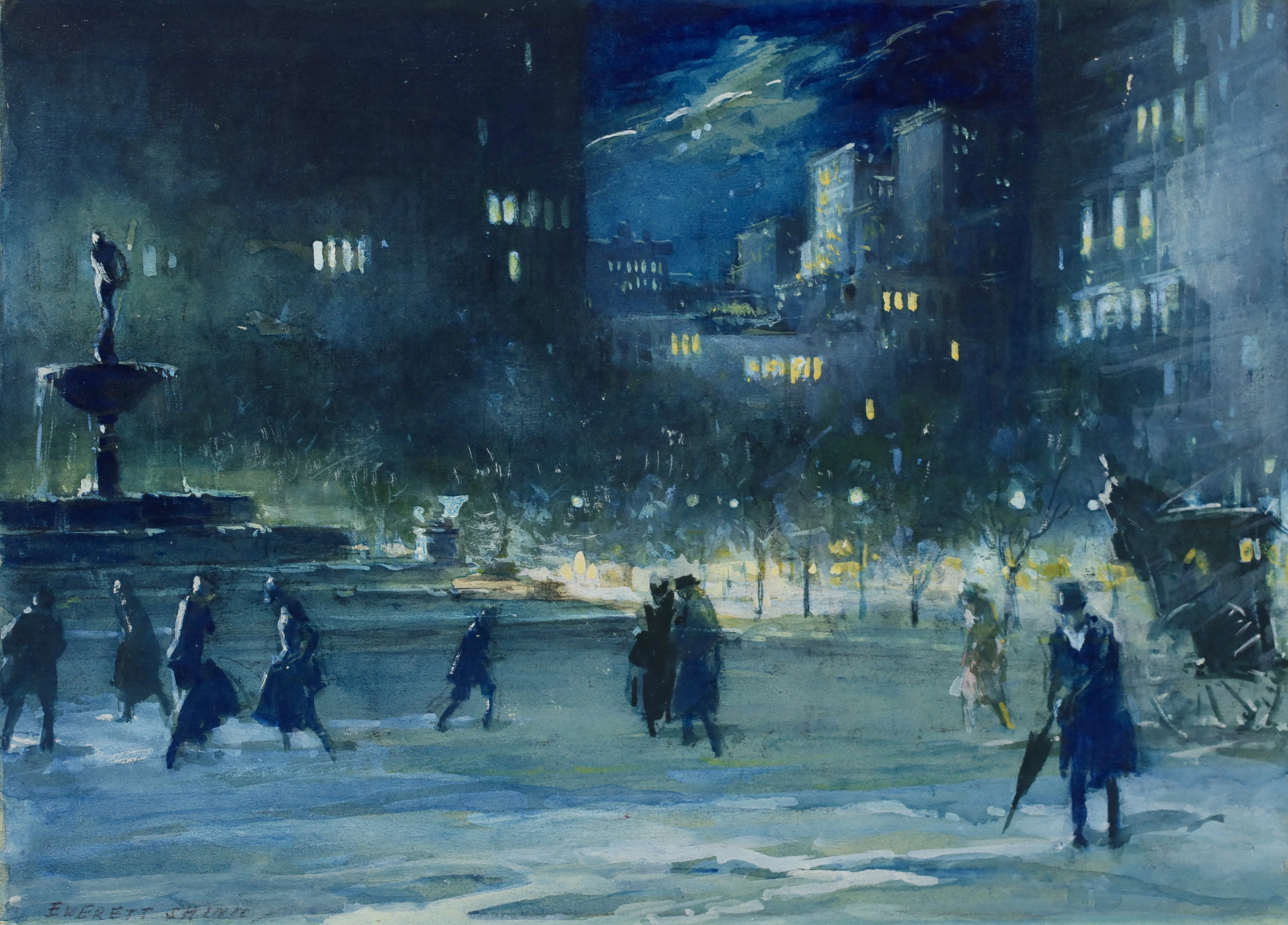
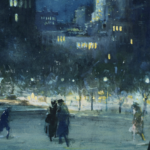
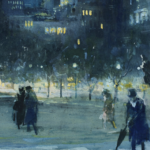
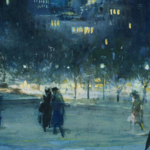
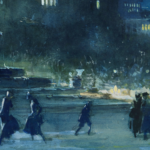
Everett Shinn was an American artist best known as a member of the Ashcan School and The Eight, a group of painters who mounted one of the most significant challenges to the conservative standards of the American art establishment in the early twentieth century. Born in Woodstown, New Jersey, in 1876, Shinn studied at the Pennsylvania Academy of the Fine Arts in Philadelphia before taking a position as a newspaper illustrator for the Philadelphia Press. It was during this formative period that he developed the rapid, observational sketching style that would define much of his career, capturing scenes of urban life with an immediacy and energy that set him apart from the academic painters of his generation.
It was also in Philadelphia that Shinn fell in with the circle of artists who would later form The Eight. The group coalesced around the charismatic figure of Robert Henri, a painter and teacher who argued passionately that American art should engage with the realities of contemporary life rather than retreating into historical, mythological, or sentimental subject matter. Henri's orbit in Philadelphia included John Sloan, William Glackens, and George Luks — all, like Shinn, working as newspaper illustrators — as well as the more stylistically independent painters Ernest Lawson, Maurice Prendergast, and Arthur B. Davies. What united these artists was not a shared style but a shared conviction that the art world, dominated by the National Academy of Design, had become stale, elitist, and disconnected from the vitality of American life.
Shinn moved to New York in 1897 and quickly became fascinated by the city's theatrical world. Unlike Henri, Sloan, and Luks, who focused primarily on the gritty realities of working-class neighbourhoods — the tenements, saloons, and street scenes that would give the Ashcan School its name — Shinn gravitated towards the glamour and spectacle of the stage. His paintings and pastels frequently depicted dancers, acrobats, vaudeville performers, and theatre audiences, rendered with a fluency and elegance that owed much to the influence of Edgar Degas and Jean-Louis Forain. This theatrical preoccupation earned him a distinctive position within the group, blending the Ashcan commitment to modern subject matter with a more decorative and romantic sensibility. Where Sloan painted the elevated railway and the back alleys, Shinn painted the footlights and the curtain call. Yet both were doing the same thing — insisting that the world around them, in all its variety, was the proper subject of art.
The defining moment for The Eight came in February 1908, when the group staged an exhibition at the Macbeth Galleries on Fifth Avenue in New York. The show was organised in direct response to the National Academy's refusal to exhibit work by Henri and his associates, and it represented a deliberate act of rebellion against the academic establishment. The eight artists — Henri, Sloan, Glackens, Luks, Shinn, Davies, Lawson, and Prendergast — showed together as equals, despite their considerable stylistic differences. Davies and Prendergast, in particular, had little in common with the urban realism of the Ashcan painters, but their inclusion reinforced the group's central argument: that artistic merit should not be judged by adherence to a single approved style.
The Macbeth Galleries exhibition was a sensation. It attracted large crowds, substantial press coverage, and divided critical opinion sharply. Conservative reviewers were appalled by the subject matter — Luks's boxers, Sloan's washerwomen, Shinn's vaudeville halls — while progressive voices hailed the show as a long-overdue breath of fresh air. The exhibition subsequently travelled to eight other cities across the United States, spreading its influence far beyond New York. It is now widely regarded as a pivotal moment in the development of American modernism, opening the door for the even more radical Armory Show of 1913.
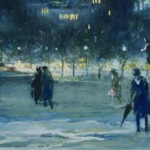
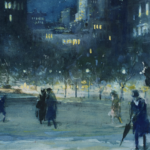
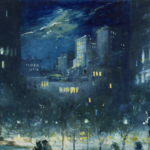
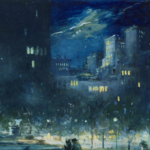
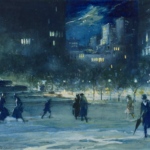
Shinn's contributions to the Macbeth exhibition included several of his theatre and performance subjects, which stood out for their compositional daring and atmospheric richness. His ability to capture the drama of artificial light — the glow of the stage, the shadows of the auditorium, the shimmer of a performer's costume — gave his work a visual intensity that distinguished it from the earthier palette favoured by Henri and Luks.
Beyond easel painting, Shinn was remarkably versatile. He worked as a muralist, completing decorations for private homes and public spaces, including the Belasco Theatre in New York — a commission that perfectly suited his lifelong fascination with the stage. He was also an accomplished playwright, set designer, and art director, working in early Hollywood on film productions. His decorative murals for the Trenton City Hall in New Jersey remain among his most significant public commissions, demonstrating a facility with large-scale composition that few of his Ashcan contemporaries could match.
Shinn's reputation has fluctuated over the decades. During his lifetime he achieved considerable commercial success, moving easily between fine art, illustration, mural painting, and theatrical design. However, his later work — which increasingly leaned towards illustration and decorative commissions — was sometimes dismissed by critics who felt he had strayed from the vitality of his earlier paintings. Among The Eight, he was perhaps the most commercially minded, and this willingness to work across disciplines occasionally counted against him in an art world that prized the singular, uncompromising vision.
In recent years, however, Shinn's contribution to American art has been reassessed. His best works are now recognised for their vivid energy, compositional sophistication, and their unique position at the intersection of realism and theatricality. He remains an essential figure in understanding The Eight — not as the most radical of the group, but as the one who most fully embodied the principle that all of modern life, from the boxing ring to the ballet, deserved the attention of serious art.
He died in New York in 1953.
Selected Museum Holdings
Metropolitan Museum of Art, New York
Whitney Museum of American Art, New York
Brooklyn Museum, New York
Museum of the City of New York
Philadelphia Museum of Art
Art Institute of Chicago
National Gallery of Art, Washington DC
Smithsonian American Art Museum, Washington DC
Detroit Institute of Arts
Munson-Williams-Proctor Arts Institute, Utica
New Jersey State Museum, Trenton
Delaware Art Museum, Wilmington
Carnegie Museum of Art, Pittsburgh
Terra Foundation for American Art, Chicago
Yale University Art Gallery, New Haven
Los Angeles County Museum of Art
Columbus Museum of Art, Ohio
Portland Museum of Art, Maine