| Medium | Oil on canvas |
| Signed | Signed lower left and titled and dated verso |
| Size | 21.50" × 36.00" (54.6cm × 91.4cm) |
| Framed Size | 29.50" × 44.00" (74.9cm × 111.8cm) |
| Dated | 1897 |
| Condition | Very good condition |
| Provenance | Private collection - France |
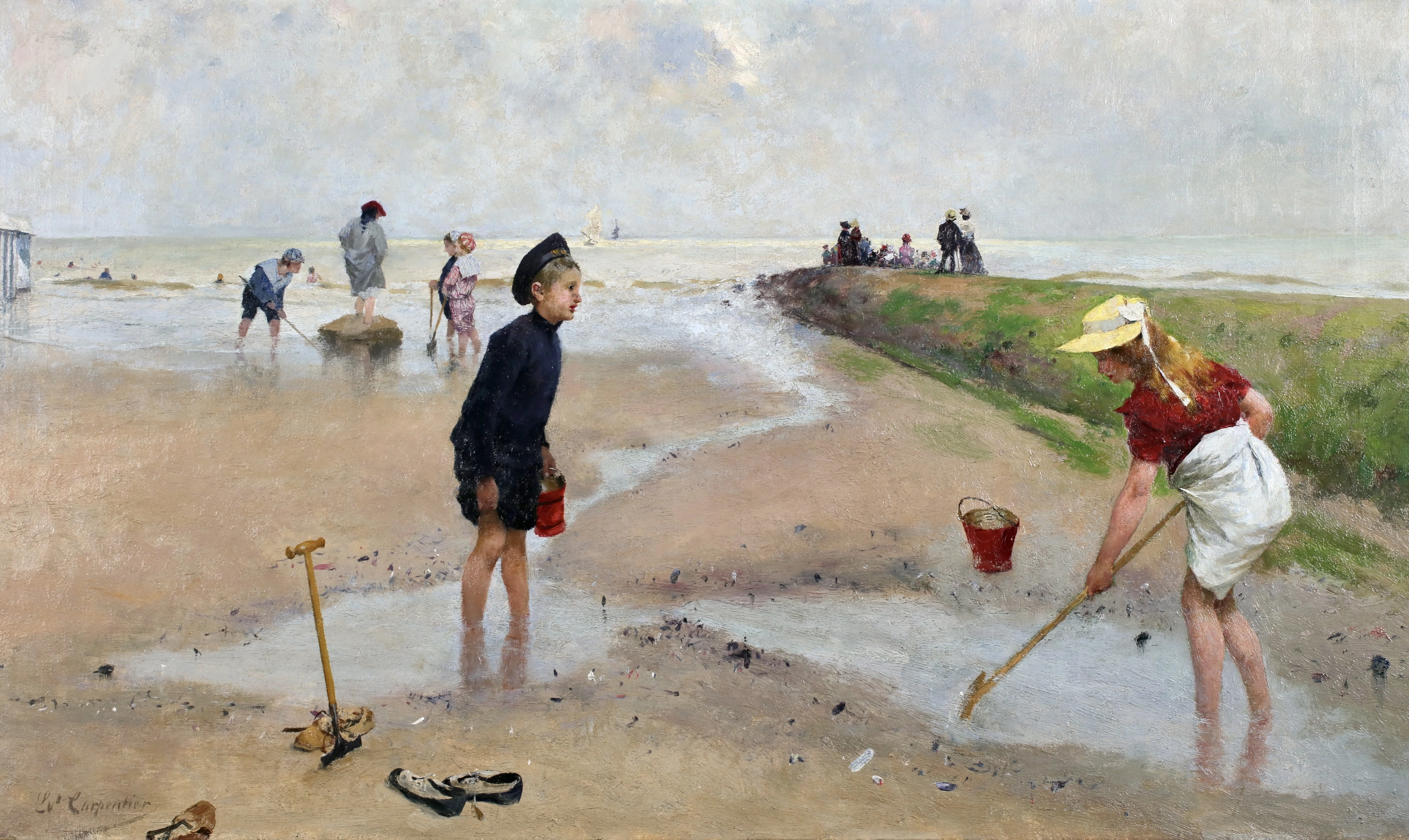
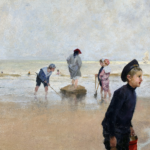
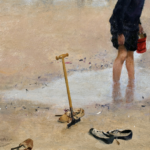
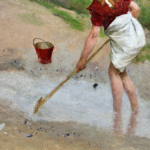
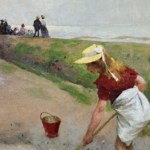
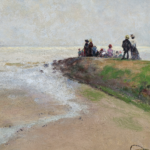
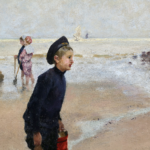
| About this Painting | The Beach at Heyst — A girl in a yellow sun-bonnet bends to her work in the shallows, rake in hand; beside her a boy in a dark bathing suit pauses with his red tin pail, the two of them digging for cockles in the wet sand left by the retreating tide. It is a small, ordinary moment on the Belgian coast, and Évariste Carpentier paints it with complete conviction — the kicked-off shoes in the foreground, the second red bucket waiting to be filled, the holidaymakers strolling the grassy dyke beyond, a single white sail on a silver horizon. Painted in 1897, this is Carpentier at the height of his powers. The palette is all pearl and silver — the soft, diffused light of an overcast North Sea morning, rendered with a delicacy that places him, alongside Emile Claus, among the earliest and finest of the Belgian Luminists. There is no drama here, and none is needed: the whole picture breathes salt air, damp sand and the particular quiet of a working beach. Carpentier (1845–1922) was born into a farming family in Kuurne and trained at the academies of Kortrijk and Antwerp before spending the 1880s in Paris, where the naturalism of Bastien-Lepage and Jules Breton drew him out of doors and lightened his palette for good. He returned to Belgium in 1886. The year he painted this beach was also the year he was appointed Professor at the Academy of Liège, where he would go on to serve as Director and teach a generation of younger painters to see in light. A gold-medal winner at Antwerp, Munich and Berlin, Carpentier is today recognised as one of the quiet masters of Belgian Impressionism — and The Beach at Heyst shows exactly why. |