
Further Images
| Medium | Oil on canvas |
| Signed | Signed lower right |
| Size | 18.00" × 26.00" (45.7cm × 66.0cm) |
| Framed Size | 25.00" × 33.00" (63.5cm × 83.8cm) |
| Dated | c. 1902 |
| Condition | Very good condition for age |
| Provenance | Private collection - United States |
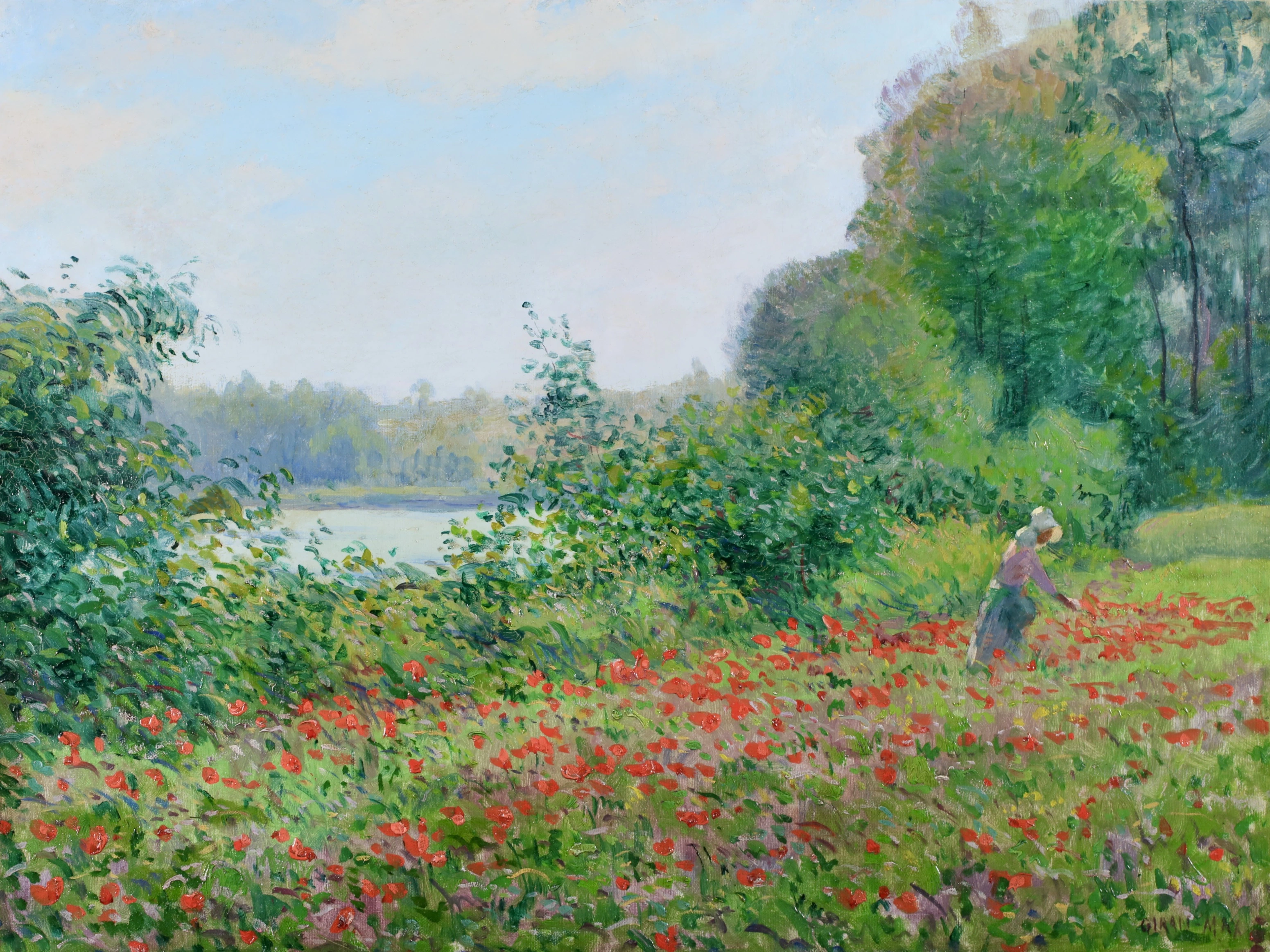
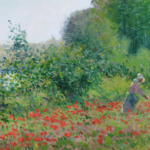
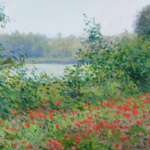
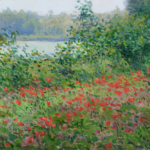
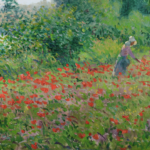
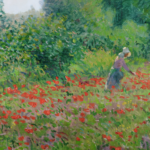
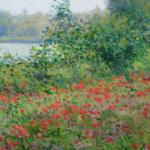
| About this Painting | A poppy field on the edge of a wood in high summer, the river showing pale and still through a gap in the scrub at the left, a line of blue-grey trees on the far bank beyond. A woman in a straw hat and dark skirt stoops at her work among the flowers at the right, the only figure. The poppies are laid in as separate strokes of pure scarlet across a meadow built from short vertical touches of acid green, olive, blue and lilac, so that the grass shimmers and the red sits on top of it rather than in it. Behind, the massed foliage is worked in curling dabs of deep green shot through with yellow, and the whole is held under a high, thin, cool sky. The picture is sunlit without being hot — a genuinely observed morning rather than a decorative one. Giran-Max was born Léon-Maxime Giran in Paris, of Languedoc peasant stock, and studied under Eugène Carrière, Henri Gervex and Alfred Roll before turning to landscape in the 1890s. He exhibited at the Société Nationale des Beaux-Arts and the Salon des Indépendants, and in 1898 Le Barc de Boutteville — the avant-garde Paris gallery that had shown Maurice Denis, Bernard, Bonnard, Signac, Luce and Toulouse-Lautrec — gave him a one-man exhibition. From his studio at Neuville-sur-Oise, downstream of Pissarro's Éragny, he worked the banks of the Oise from Conflans-Sainte-Honorine to Auvers-sur-Oise, living for a time at Le Valhermeil in the rue d'Ennery. He also painted in Spain, Brittany and the Midi. The Indépendants held a memorial tribute to him in 1928. |
£8,950.00
GBP


